
- Examining Physical Activity vs. Exercise Training at the Molecular Level
- Chapter 1: Why “Staying Active” Might Not Be Enough
- Chapter 2: A Design That Separates Age from Inactivity
- Chapter 3: Molecular Shifts in Aging Muscle Beyond Muscle Mass
- Chapter 4: What Set the Exercise-Trained Older Adults Apart?
- Chapter 5: Can Exercise Training Halt Aging Entirely?
- Chapter 6: Fitness Levels and Acute Stress Responses
- Chapter 7: NAD⁺ Dynamics and Proteasome Function
- Chapter 8: Implications for Masters Athletes and Aging Individuals
- Conclusion: Navigating Between Inevitability and Adaptability
- References
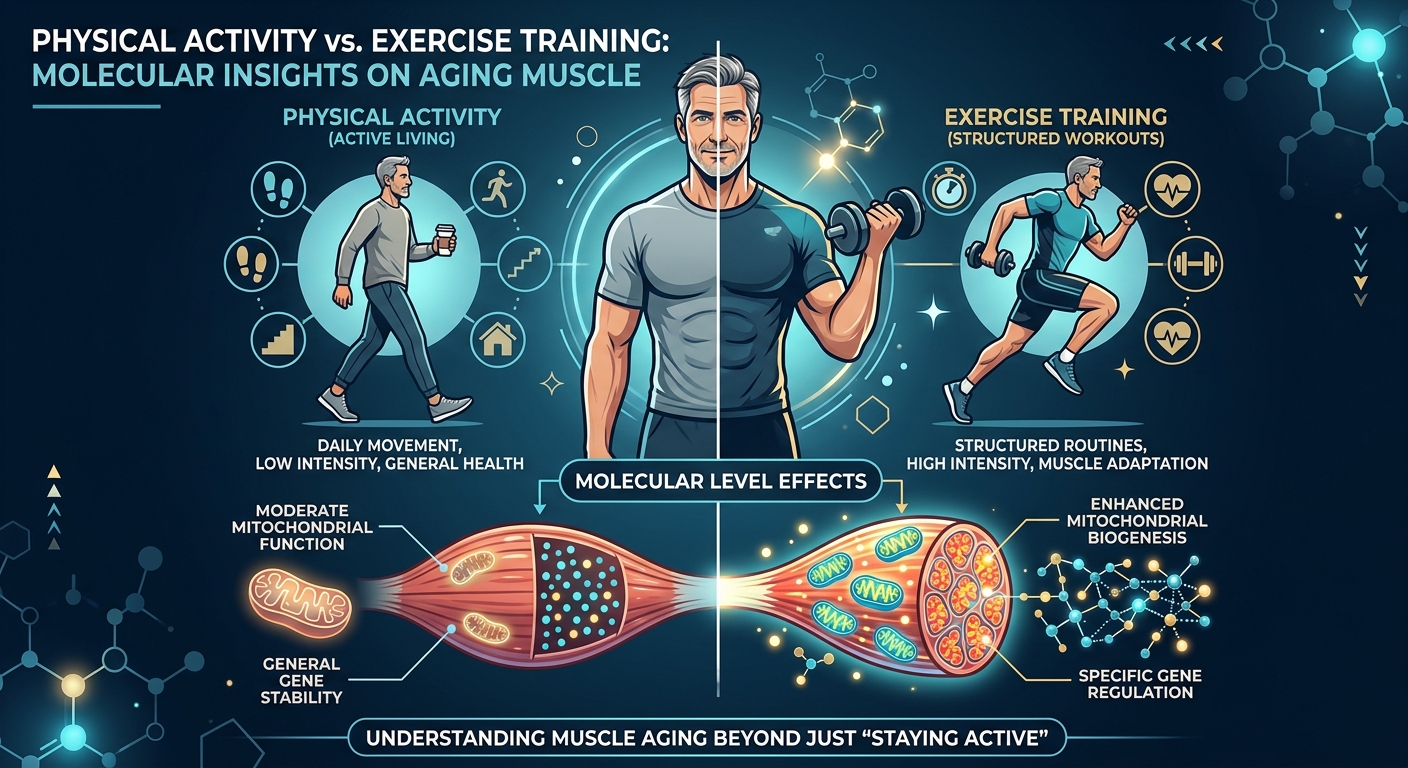
Examining Physical Activity vs. Exercise Training at the Molecular Level
It is widely known that as we age, muscle mass declines, accompanied by a reduction in strength and endurance. Generally, physical inactivity and a sedentary lifestyle are believed to accelerate this decline. Consequently, public health advice frequently encourages us to take more steps and stay movement-oriented throughout daily life.
This raises a fundamental question:
Do the muscles of physically active older adults maintain the same biological state as those of younger individuals?
If someone walks daily, leads an active lifestyle, and minimizes sitting time, do age-related molecular changes still progress within their skeletal muscle? If such changes persist despite high daily physical activity, this raises a potentially important biological distinction between everyday Physical Activity and structured Exercise Training, which provides repeated stimuli that can drive physiological adaptation.
Drawing upon a 2026 study published in Nature Aging by Janssens et al., this article examines the molecular changes in aging skeletal muscle and investigates how physical activity versus structured exercise training influences these processes.
Chapter 1: Why “Staying Active” Might Not Be Enough
We frequently hear advice like, “I make sure to walk more as I get older” or “I try to stay as active as possible during the day.” Public health guidelines rightly emphasize the importance of maintaining adequate daily physical activity.
However, behind the premise that “inactivity causes decline” lies a separate question that requires careful scrutiny: Is staying physically active sufficient on its own to prevent age-related decline?
If age-related alterations in muscle physiology and molecular profiles occur even in individuals who maintain high daily activity levels, then muscle aging cannot be explained solely by inactivity.
Mechanical and metabolic stimuli vary significantly in nature. Low-intensity daily movements accumulated over long periods exert one type of stimulus, whereas structured exercise training imposes specific intensities and workloads that stimulate biological adaptations at the cellular level. This raises an important distinction: are we confusing being physically active with providing consistent, adaptive exercise stimuli to skeletal muscle?
Disentangling this distinction requires a study design that rigorously controls for both age and physical activity levels.
Chapter 2: A Design That Separates Age from Inactivity
The 2026 study by Janssens et al., conducted by a research team in the Netherlands, offers a comprehensive molecular profiling of human skeletal muscle.
A major strength of this study lies in its participant stratification and physical activity controls. The researchers categorized subjects into four distinct groups:
- Young Adults (Young): Healthy individuals in their 20s.
- Normally Active Older Adults: Older adults without age-related functional impairment who do not engage in structured exercise training.
- Trained Older Adults: Older adults with a long-term history of structured exercise training, including aerobic and resistance exercise.
- Impaired Older Adults: Older adults exhibiting frailty or compromised physical function.
Crucially, daily physical activity levels were comparable between the Young Adults and Normally Active Older Adults. This design helps separate age-related differences from differences that could otherwise be explained by lower habitual physical activity.
Muscle biopsy samples were collected from the vastus lateralis (thigh muscle) of participants and subjected to multi-omics analysis:
- Transcriptomics: Comprehensive analysis of gene expression in muscle tissue.
- Metabolomics: Profiling of intracellular metabolites.
- Lipidomics: Detailed analysis of lipid species.
- Integration with Physiological Data: Integration of molecular profiles with physiological measures of mitochondrial function and physical performance from the study cohort.
Rather than relying solely on conventional measures of muscle function or physical performance, this study examines the underlying molecular programs and metabolic pathways operating within muscle cells.
Chapter 3: Molecular Shifts in Aging Muscle Beyond Muscle Mass
When comparing gene expression profiles between Young Adults and Normally Active Older Adults, the researchers identified 1,106 genes showing age-related downregulation.
Functional pathway analysis revealed that these downregulated genes were heavily concentrated in cellular respiration and energy metabolism. Notable expression changes were observed in genes encoding components of the mitochondrial electron transport chain and ATP synthesis machinery.
Metabolomic profiling further demonstrated lower levels of nicotinamide adenine dinucleotide (NAD⁺)—an essential coenzyme in cellular energy metabolism—and higher levels of intramyocellular triglycerides in normally active older adults.
Muscle aging is often discussed through the lens of sarcopenia—the age-related loss of muscle mass and area. However, these findings indicate that even when daily physical activity is maintained, significant shifts occur in the molecular programs governing energy metabolism inside muscle cells.
These observations should not be interpreted as an immediate state of cellular energy failure. Rather, they demonstrate that transcript levels and metabolite profiles linked to energy production undergo characteristic age-related shifts that extend beyond simple changes in muscle quantity.
Chapter 4: What Set the Exercise-Trained Older Adults Apart?
The core findings of the study emerge when examining the Trained Older Adults—individuals who maintained structured exercise training over many years.
In this group, the age-related gene expression changes observed in normally active older adults were markedly attenuated.
Specifically, among the age-related gene expression changes identified in normally active older adults, 55.9% of the upregulated genes and 57.1% of the downregulated genes showed no significant age-related changes in the Trained group. In study summaries, this finding is broadly described as approximately half of age-related gene expression changes being absent in trained older adults.
For instance, age-related expression changes in genes encoding key components of the mitochondrial respiratory chain—such as NDUFS1 (Complex I) and COX5A (Complex IV)—showed attenuated age-related changes in trained older adults, with expression levels closer to those of young adults.
Scientific Context Regarding the Percentages
Careful interpretation is required when evaluating these figures (55.9% and 57.1%, or approximately half).
These values do not demonstrate a direct causal proof that exercise training “prevents 50% to 57% of human muscle aging.” Because this study employed a cross-sectional observational design, the percentages reflect the proportion of identified age-related gene expression differences that were absent in the trained cohort at the time of sampling.
Furthermore, participants in the trained group were not randomly assigned; they consisted of individuals capable of sustaining regular exercise training over long periods. Self-selection bias cannot be entirely excluded, as these individuals may possess baseline genetic or physiological traits that favor higher metabolic function and exercise adherence.
Nevertheless, the presence of distinct molecular profiles between individuals with similar high daily physical activity levels—differing primarily in structured exercise habits—is highly informative. It suggests that casual physical activity (such as walking or reducing sitting time) and structured exercise training may provide different patterns and magnitudes of biological stimulation to skeletal muscle.
Chapter 5: Can Exercise Training Halt Aging Entirely?
Does long-term structured exercise training completely prevent muscle aging? The study’s data indicate that it does not.
Even in the Trained Older Adults, specific age-related molecular differences persisted when compared directly to Young Adults. These persistent differences were notably concentrated in specific functional categories:
- Genes involved in neural and synaptic transmission
- Genes involved in developmental and signaling processes (such as WNT signaling)
Despite years of structured aerobic and resistance training, these specific gene sets still showed age-related differences when compared with young adults.
Distinguishing Exercise-Responsive from Persistent Age-Related Domains
These findings caution against both oversimplified claims that exercise completely halts aging and defeatist views that aging is entirely unalterable. Instead, they suggest that molecular aging in muscle consists of distinct domains:
- Domains responsive to exercise stimuli: Primarily pathways governing energy metabolism and mitochondrial respiration.
- Domains displaying persistent age-related changes: Pathways related to synaptic transmission and developmental or signaling processes that remained altered under the studied exercise conditions.
These results do not imply that neural or developmental/signaling pathways are completely unresponsive to all forms of exercise. Variations in training intensity, volume, modality (such as high-intensity interval training or heavy power training), or timing could yield different responses. The key takeaway is that muscle aging should be viewed as a multi-layered process rather than a uniform phenomenon.
Chapter 6: Fitness Levels and Acute Stress Responses
One of the most unexpected findings emerged from measuring immediate molecular responses following a 1-hour cycling bout performed at 50% of individual peak power output (W_peak).
A common assumption is that well-trained muscle remains relatively undisturbed by exercise stress, exhibiting minimal inflammatory or stress signaling, whereas less fit or physically impaired muscle experiences pronounced cellular stress. However, the data revealed a different pattern.
Immediately following exercise, all participant groups exhibited transcriptional immune and stress responses, including changes in genes such as IL6, IL1B, TNF, SELE, and FOS. When evaluating the dynamic transcriptomic response—measured by similarity to the response pattern observed in young adults—the similarity scores ranked as follows:
Trained (0.451) > Normally Active (0.394) > Impaired (0.263)
Older adults with higher physical fitness displayed acute transcriptional responses that more closely resembled those of young adults. Conversely, older adults with lower physical capacity (Impaired group) exhibited blunted transcriptional responses at the same relative intensity.
Acute Exercise Responses vs. Chronic Systemic Inflammation
This finding highlights an important distinction in exercise physiology. An acute, transient stress and inflammatory response immediately following exercise does not simply signify tissue damage; it may represent part of the signaling processes involved in cellular adaptation.
While chronic, low-grade systemic inflammation (inflammaging) impairs tissue function over time, transient acute stress responses triggered by exercise serve a different biological purpose. The magnitude of this acute transcriptional response was positively associated with physical fitness.
Note: This observational finding does not establish that acute stress signaling directly causes long-term training adaptations, nor does it justify broad clinical claims regarding anti-inflammatory interventions. However, it underscores the importance of distinguishing acute exercise-induced stress signals from chronic baseline inflammation.
Because trained individuals possess higher absolute work capacities, exercising at 50% of individual peak power output entailed higher absolute power output (watts) and energy expenditure compared to less fit individuals. Whether the heightened acute response stems from higher physical fitness, greater absolute workload, or an integration of both remains an important consideration.
Chapter 7: NAD⁺ Dynamics and Proteasome Function
The multi-omics dataset also provided insights into NAD⁺, a coenzyme central to energy metabolism and multiple cellular processes that typically declines with age.
Correlation analyses between muscle NAD⁺ levels and global gene expression revealed two distinct patterns:
- Positive correlation: Genes related to mitochondrial respiration and energy metabolism (consistent with established metabolic physiology).
- Negative correlation: Genes associated with the ubiquitin-proteasome system, a major pathway involved in the degradation and clearance of cellular proteins.
Higher expression of proteasome-related genes was inversely associated with cellular NAD⁺ content.
To test this interaction experimentally, the researchers treated cultured muscle cells (C2C12) and liver cells (AML12) with the proteasome inhibitor MG-132. Pharmacological inhibition of proteasome activity resulted in an increase in intracellular NAD⁺ levels.
Interpreting the NAD⁺ Findings
These cell culture experiments should not be misinterpreted as a rationale for inhibiting proteasome function to boost NAD⁺ or slow aging.
MG-132 is a research compound, not a therapeutic agent. Disrupting proteasome function can cause cellular toxicity because protein quality control is essential for cell survival.
The biological significance of this finding lies in suggesting that intracellular NAD⁺ availability is not determined solely by precursor supply (such as NMN or NR supplementation). Instead, NAD⁺ availability may be linked to broader metabolic processes, including protein turnover rates and the energetic costs of protein degradation.
Chapter 8: Implications for Masters Athletes and Aging Individuals
What framework does this study offer for masters athletes and individuals seeking to preserve physical capacity throughout aging?
While the study does not directly compare specific exercise protocols (such as HIIT versus heavy resistance training), it provides a clear conceptual framework for structuring physical activity and training:
1. Differentiating Physical Activity from Adaptive Training
Maintaining daily physical activity and step counts provides an essential foundation for general health. However, the findings suggest that structured exercise training may provide additional stimuli for maintaining mitochondrial and energy-metabolism programs in skeletal muscle beyond those provided by habitual physical activity alone.
2. Implementing Diverse Training Stimuli
Given that age-related changes occur across multiple biological pathways, training programs should incorporate varied stimuli:
- Aerobic & Mitochondrial Stimuli: Sustained endurance training to target oxidative capacity.
- Neuromuscular & Structural Stimuli: Progressive resistance training to support muscle strength, neuromuscular function, and muscle mass.
- Neuromotor & Power Stimuli: Dynamic movements emphasizing speed, force development, and coordination.
- Systemic Recovery: Adequate recovery periods to allow cellular adaptation to occur.
The findings also raise the possibility that different training stimuli may influence different aspects of muscle biology, although this was not directly tested in the present study.
Conclusion: Navigating Between Inevitability and Adaptability
When addressing physical changes associated with aging, discussions often drift toward two extremes:
- Deterministic resignation: Assuming all decline is entirely inevitable due to chronological age.
- Unconditional optimism: Assuming optimal exercise can entirely prevent or reverse all aspects of aging.
The findings from Janssens et al. (Nature Aging, 2026) offer a nuanced, evidence-based perspective between these positions.
Many age-related molecular changes in skeletal muscle—particularly those involving cellular respiration and energy metabolism—were less pronounced in individuals with long-term structured exercise training. This indicates that several changes often attributed purely to chronological age may reflect not only chronological aging but also differences in long-term exercise exposure.
At the same time, certain molecular pathways (such as specific neural, developmental, and signaling pathways) exhibit persistent age-related differences despite long-term training. Exercise training modifies key metabolic systems, but it does not eliminate every biological marker of aging.
The value of this research lies not in chasing an idealized past state, but in recognizing two coexisting realities:
- Some physiological and molecular shifts persist with age despite long-term physical activity and structured training.
- Some functional declines may reflect insufficient exposure to structured, adaptive stimuli in addition to the effects of aging.
Understanding which physiological systems adapt readily to structured exercise—and which require tailored strategies—allows masters athletes and active individuals to design training programs with clarity, purpose, and scientific perspective.
References
- Janssens, G.E., Trętowicz, M.M., Grevendonk, L. et al. Delayed molecular aging, preservation of energy metabolism and enhanced exercise response in exercise-trained human muscle. Nat Aging 6, 1482–1500 (2026). PMID: 42399371
- Cartee, G.D., Hepple, R.T., Bamman, M.M., Zierath, J.R. Exercise promotes healthy aging of skeletal muscle. Cell Metab 23, 1034–1047 (2016). PMID: 27304502
- Hood, D.A., Memme, J.M., Oliveira, A.N., Triolo, M. Maintenance of skeletal muscle mitochondria in aging. J Physiol 597, 1349–1361 (2019). PMID: 30588636
コメント