
Earlier on this blog, I published an article titled “Aging”? No, It’s Just “Degeneration.” — Face Reality, Masters Athletes.
The core message was the importance of distinguishing between aging—the unavoidable biological decline that comes with time—and degeneration, which is the loss of physical function simply due to disuse.
Many athletes assume their declining performance is simply the inevitable result of aging and resign themselves to it. However, a significant portion of that loss is actually just degeneration caused by a lack of appropriate physical stimuli.
Currently competing as a triathlete across swim, bike, and run at age 55, daily training has made those declines impossible to ignore.
Specifically, there is a clear delay in recovery. It has become physically difficult to handle demanding schedules like competing in races three weekends in a row, as was once possible. Fatigue from daily sessions lingers well into the next day. Furthermore, the feel of the ground underfoot and the crispness of movement have dulled; stride length has shortened, and ground contact time feels noticeably longer.
Even after putting in sufficient training volume, these negative changes still occur. That is because the body, when exposed only to the same repetitive stimuli, optimizes for that specific routine and gradually lets unused functions decline.
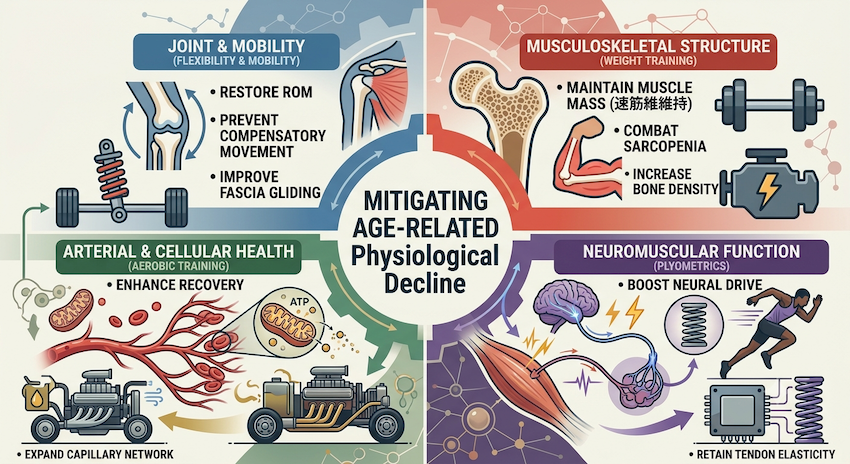
From an exercise physiology standpoint, as we age, it is not just muscle mass and maximum strength that decline. The neural drive sending signals from the brain to the muscles slows down, tendon elasticity (such as in the Achilles) degrades, mitochondrial efficiency at the cellular level drops, and capillary density decreases. These physiological shifts directly surface as a decline in athletic performance.
Regardless of age, the goal for many is to move freely and enjoy sports for as long as possible. To maintain a high level of performance in triathlon at this stage, it is necessary to move away from mindless training, clarify objectives, and take a strategic approach to physical conditioning.
Age-related changes occur simultaneously across different systems—muscles, nerves, joints, and cellular structures—each driven by distinct mechanisms. Countering this decline requires a multi-faceted strategy with clearly defined roles for each component.
Through years of training and experimentation, four elements have emerged as indispensable:
- Flexibility & Mobility
- Weight Training
- Plyometrics
- Aerobic Conditioning (Zone 2)
I believe these four pillars are essential for fighting age-related degeneration and unlocking further adaptation. Below is a breakdown of the physiological mechanisms behind each pillar, detailing their specific roles and necessity for longevity in sports.
- Conceptual Overview of the 4 Pillars
- 1. Flexibility & Mobility: Maintaining a “Mobile” Foundation
- 2. Weight Training: Maintaining a “Strong” Physical Structure
- 3. Plyometrics: Maintaining “Sharpness” and Rapid Force Transmission
- 4. Aerobic Conditioning (Zone 2): Maintaining “Endurance” and System Sustainability
- The Synergy Among the 4 Pillars
- Conclusion: The Possibilities of Strategic Stimuli
Conceptual Overview of the 4 Pillars
To visualize how these four elements support physical function, consider the concept below. The target areas barely overlap; instead, they support the center from four distinct directions.
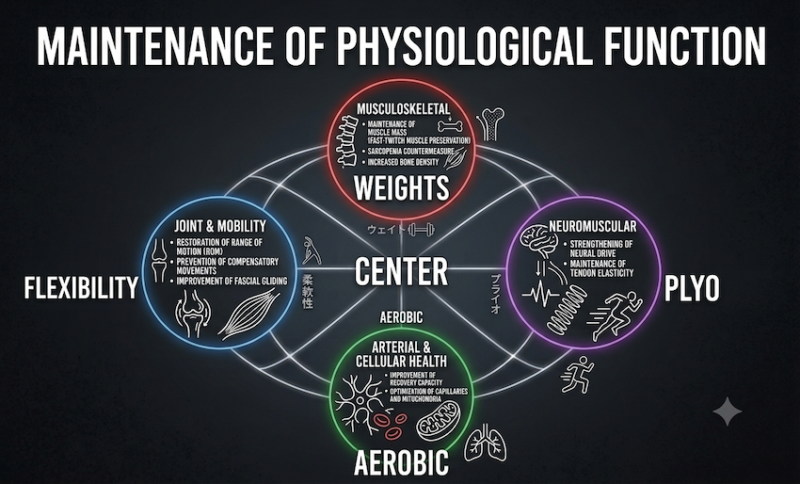
Here is a summary of the physical functions prone to age-related decline and the corresponding pillars prioritized to prevent them:
| Element | Target Area | Specific Functional Loss Prevented | Analogous Role (Vehicle) |
| Flexibility & Mobility | Joint Range of Motion (ROM), Fascial Glide | Stiffening of hips/thoracic spine, injuries from compensatory movement | Suspension (Shock Absorption & Alignment) |
| Weight Training | Muscle Mass (Fast-Twitch), Strength, Bone Density | Sarcopenia, loss of maximal power output | Engine (Physical Displacement & Horsepower) |
| Plyometrics | Neural Drive, Tendon Elasticity (SSC) | Prolonged ground contact time, sluggish reaction speed | ECU & Electronics (Control & Transmission) |
| Aerobic (Zone 2) | Mitochondria, Capillary Density, Cardiorespiratory | Metabolic inefficiency, delayed recovery | Fuel Efficiency, Cooling & Fluid Circulation |
These four pillars cover the major physical functions most susceptible to age-related decline—muscle mass, strength, Rate of Force Development (RFD), mobility, and aerobic capacity. Each acts from a different angle to put the brakes on age-related decline.
1. Flexibility & Mobility: Maintaining a “Mobile” Foundation
Maintaining joint mobility and fascial glide is a prerequisite for all human movement. No matter how much raw strength or cardiorespiratory fitness is present, if the physical frame cannot move freely, that power cannot be expressed. In running, for example, propulsive force fails to transfer forward efficiently, wasting energy with every stride.
Why It Declines
As tissue hydration decreases with age, collagen fibers lose their elasticity. Coupled with years of repetitive training patterns and daily postural habits, the fascia surrounding muscles and adjacent tissues can form adhesions. This reduces fascial glide, naturally restricting joint Range of Motion (ROM).
Why This Pillar Is Necessary
For triathletes, the core issue caused by joint stiffness is compensatory movement.
The human body naturally alternates between joints that require mobility and joints that require stability. Key mobility joints—such as the hips and thoracic spine needed for an aggressive aero position on the bike, or the ankles absorbing impact during the run—must move freely. When these mobility joints become restricted, neighboring joints are forced to compensate (such as the lumbar spine or knees).
This mechanism—where an inappropriate area forces movement to make up for a restriction elsewhere—is called compensation. Compensatory movement places unnatural stress on vulnerable structures, ultimately leading to chronic overuse injuries.
Adequate flexibility and mobility remove unnecessary internal resistance and restore balance between agonist and antagonist muscles. Acting like a high-performance suspension system, mobility distributes mechanical stress correctly, allowing maximum output with minimal wasted energy. Keeping joints and fascia moving smoothly is the absolute foundation for elevating overall training efficiency.
2. Weight Training: Maintaining a “Strong” Physical Structure
Heavy resistance training is essential for preserving skeletal muscles and the structural density of the bones that support them. No matter how many hours of long-distance aerobic training are logged, endurance exercise alone cannot fully stop structural degeneration.
Why It Declines
Age-related loss of muscle mass and strength eventually leads toward sarcopenia if left unchecked. Skeletal muscle consists primarily of slow-twitch fibers (suited for endurance) and fast-twitch fibers (suited for high power). Aging preferentially degrades and atrophies fast-twitch muscle fibers.
Because endurance sports like triathlon predominantly recruit slow-twitch fibers, routine running and cycling do not provide sufficient stimulus to fast-twitch fibers to prevent atrophy. Furthermore, endurance training offers limited mechanical strain on bones, failing to fully prevent age-related losses in bone mineral density.
Why This Pillar Is Necessary
By applying progressive overload through weight training, fast-twitch fibers that remain untouched during lower-intensity aerobic workouts are forcefully recruited, helping prevent their age-related atrophy.
Building maximal strength also lowers the relative load required for submaximal efforts. When the absolute force ceiling increases, holding a specific running pace or cycling wattage requires a smaller percentage of total strength, making the effort feel less fatiguing.
Additionally, the heavy tensile and compressive forces applied during lifting activate osteoblasts, maintaining and enhancing bone density. Heavy loading acts as an essential stimulus to maintain the body’s structural foundation—a solid physical frame capable of handling high impacts and long training volumes.
3. Plyometrics: Maintaining “Sharpness” and Rapid Force Transmission
Plyometrics stimulates the Stretch-Shortening Cycle (SSC)—the elastic recoil mechanism where a muscle rapidly stretches and then immediately contracts like a spring. To preserve movement sharpness that pure strength training cannot provide, plyometrics is critical.
Why It Declines
Age-related performance drops are heavily tied to changes in the nervous system and tendon properties, not just muscle volume.
The neural pathways transmitting signals from the brain to muscles—along with the number of active motor units—decline with age. This slows neural conduction velocity and reduces muscle recruitment efficiency. Furthermore, tendons (such as the Achilles) lose their natural compliance, becoming stiff and less capable of storing and releasing elastic energy.
Why This Pillar Is Necessary
Even with impressive muscular strength built from weight training, if Rate of Force Development (RFD)—the speed at which force can be expressed—declines, ground contact time will inevitably lengthen.
When ground contact time increases, ground reaction forces can no longer be efficiently converted into forward propulsion. Instead, the body is forced forward using raw muscular effort alone. This is the true physiological cause behind feeling sluggish. A sluggish nervous system also delays the ability to regain balance during unexpected missteps.
Plyometric exercises, such as jumps and bounding, train the body to exert maximum force in tiny time windows of 100 to 200 milliseconds. This helps improve neural drive and preserves the elastic spring of tendons. By keeping the control unit and neural wiring updated, dynamic, spring-like movement that bounces off the ground can be retained.
4. Aerobic Conditioning (Zone 2): Maintaining “Endurance” and System Sustainability
A powerful engine (muscles) and a sharp transmission system (nervous system) are useless if energy cannot be supplied efficiently or if the underlying system cannot operate sustainably over time.
Why It Declines
At the cellular level, the main culprit is the decline in both the function and quantity of mitochondria—the powerhouses of energy metabolism. When mitochondrial function drops, the body loses its ability to efficiently burn fat for fuel (ATP), shifting toward a heavy reliance on carbohydrates. This leads to premature fatigue and rapid accumulation of metabolic byproducts.
Simultaneously, the microscopic network of capillaries degrades over time (capillary rarefaction). This constricts the supply lines delivering oxygen and nutrients to working muscles and hinders the removal of metabolic waste—a primary cause of the delayed recovery that plagues veteran athletes.
Why This Pillar Is Necessary
Low-intensity aerobic training focused on Zone 2 is the most powerful countermeasure against this cellular decline.
For long-distance triathlon, Zone 2 intensity is the optimal zone for maximizing fat oxidation. Sustained training in this zone triggers mitochondrial biogenesis—stimulating the creation of new mitochondria and enhancing existing ones. Continuous, low-stress blood flow also expands and maintains the capillary network.
Establishing this cellular infrastructure ensures efficient energy distribution throughout the entire body. Furthermore, a highly developed vascular network rapidly flushes out training-induced fatigue, fundamentally strengthening the capacity to recover between hard sessions.
The Synergy Among the 4 Pillars
While these four approaches target distinct areas, they complement each other, creating a powerful synergy that maximizes physical potential:
- Aerobic Fitness Enhances Lifting & Plyometrics:Heavy resistance and plyometric training put high demands on muscles and nerves. Rapid recovery between sets and efficient tissue repair depend directly on the capillary network and mitochondrial capacity developed through Zone 2 aerobic work. A strong cardiovascular foundation allows sustained, high-quality strength training.
- Strength & Plyometrics Elevate Aerobic Efficiency:No matter how strong lungs and heart are, if energy leaks out through unstable joints or slow ground contact times, endurance performance suffers. Strong muscles and elastic tendons allow ground forces to be stored and released efficiently, lowering the energy cost of every stride or pedal stroke.
- Mobility Keeps Everything Operating Safely:High force and rapid reactions require joints to move cleanly in their natural alignment. If stiff joints cannot absorb impact, generated forces travel into unsupported tissues, inevitably leading to injury.
Conclusion: The Possibilities of Strategic Stimuli
When exposed to the exact same training stress day after day, the body adapts to that baseline and stops changing. For athletes over 40, preventing this plateau and continually provoking dormant physical systems is the key to maintaining performance.
Consistently introducing distinctly different stimuli—activating cells, reinforcing structural strength, accelerating neural drive, and maintaining smooth fascial glide—is the ultimate defensive strategy.
Aging itself is unavoidable. However, it is possible to minimize what is lost and maximize what can still be built. Strategically combining different types of training stimuli to protect and develop each physical system is, I believe, perhaps the most realistic strategy for continuing to enjoy sport and perform at a high level well beyond the age of 40.

コメント