
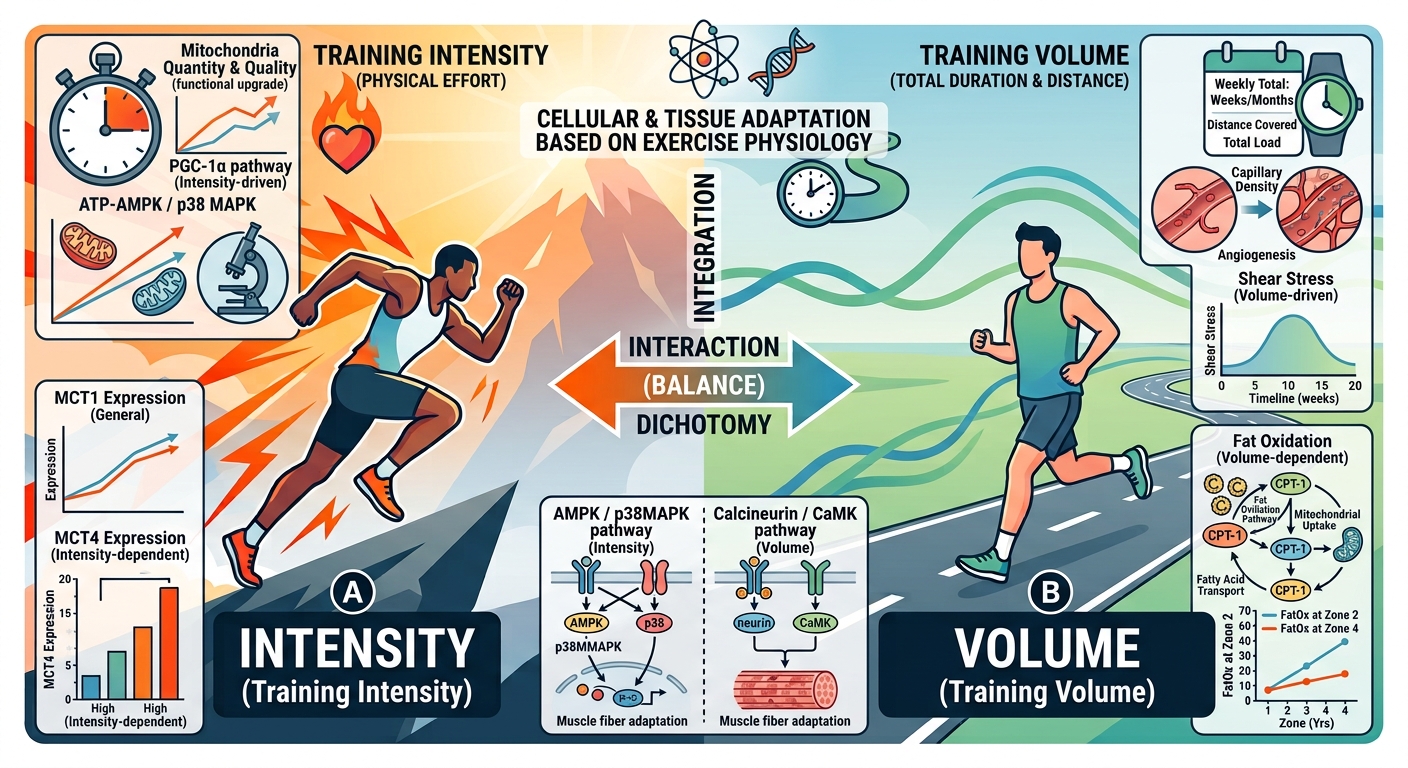
In endurance sports training theory, the debate over whether to prioritize training intensity or training volume is seemingly endless. Advocates for efficiency often champion high-intensity interval training (HIIT) to achieve adaptations in shorter timeframes, while traditional volume-based approaches emphasizing distance or duration remain deeply entrenched.
However, examining exercise physiology reveals that the binary question—”intensity versus volume”—fundamentally misunderstands the nature of training stimuli.
Intensity and volume provide distinct stimulus characteristics to the body, inducing overlapping yet functionally separate adaptations. This article outlines how these two inputs act at the cellular and tissue levels, offering a scientific framework to identify the specific bottlenecks limiting your endurance performance.
📌 Key Takeaways
Volume and Intensity are not opposing concepts. Riding 100 km does not automatically mean “high intensity,” nor does a 20-minute VO2max interval session imply “insufficient volume.” They represent fundamentally different stimulus metrics.
Volume containing low- to moderate-intensity prolonged exercise builds metabolic infrastructure. Through cumulative stimulation, sustained volume promotes capillary network expansion, structural fatigue tolerance, and long-term cardiorespiratory and musculoskeletal adaptations.
High-intensity stimuli challenge high-output systems and central circulation. Exercises performed near VO2max impose substantial loads on stroke volume and oxygen delivery mechanisms, while powerfully driving neuromuscular recruitment and lactate kinetics.
“80/20” (Polarized Training) is not an absolute rule. Recent meta-analyses indicate that training distribution effectiveness depends on athlete level and targeted performance outcomes (e.g., VO2peak vs. time-trial performance); the evidence does not support a single universally superior model.
The central question is: “What bottleneck is currently limiting my performance?” Rather than forcing training into rigid formulas or arbitrary ratios, performance optimization relies on selecting the exact physiological stimulus required for your current adaptation phase.
- 1. “Volume” and “Intensity” Are Not on the Same Axis
- 2. Physiological Stimuli and Distinct Adaptation Responses
- 3. Mitochondrial Content vs. Mitochondrial Function
- 4. VO2max Alone Does Not Fully Explain Endurance Performance
- 5. Long-Term Infrastructure Development via “Volume”
- 6. The Value of “Intensity” in High-Output and Neuromuscular Systems
- 7. “80/20” Is a Distribution Strategy, Not an Inviolable Law
- 8. Identifying Your Current “Bottleneck”
- References
1. “Volume” and “Intensity” Are Not on the Same Axis
When evaluating training components, we must first establish clear definitions for Volume and Intensity. They represent distinct dimensions and cannot be plotted or directly compared on a single linear continuum.
1-1. Fundamental Training Variables
The primary variables defining training load include:
- Intensity: An indicator of how hard the exercise is being performed relative to capacity or output (%VO2max, %HRmax, FTP, pace, etc.).
- Volume: A neutral metric representing the total amount of exercise performed over a given period (e.g., total distance, total exercise duration).
- Duration: The elapsed time of a single training session.
- Frequency: The number of training sessions per unit of time (e.g., sessions per week).
- Density: The amount of work performed relative to the recovery time between bouts or intervals.
It is critical to note that composite metrics like Training Stress Score (TSS)—which combine exercise duration with a nonlinear measure of relative intensity—represent overall Training Load rather than pure Volume. Furthermore, “Volume” is not synonymous with “low-intensity exercise.” Volume is inherently a neutral concept describing total exercise quantity, regardless of the intensity zones in which that work was executed.
1-2. Stimuli along Distinct Axes
A 100 km low-intensity ride cannot be characterized as “high intensity.” Conversely, a 20-minute VO2max interval session cannot be deemed “sufficient volume.”
High-intensity/low-volume training and low-intensity/high-volume training do not merely achieve identical physiological outcomes through different means. They impose distinct metabolic and mechanical stresses upon skeletal muscle and the cardiovascular system, triggering distinct adaptation pathways.
2. Physiological Stimuli and Distinct Adaptation Responses
Depending on the primary characteristic of a training stimulus—whether high power output or extended duration—the muscular and cardiovascular systems exhibit different physiological adaptations.
2-1. Adaptations Driven by Prolonged and Repetitive Exercise
Prolonged exercise, particularly when repeated over time, provides a cumulative stimulus that cannot be explained by session intensity alone.
- Capillary Network Adaptation: Exercise increases skeletal muscle blood flow, vascular endothelial shear stress, and localized metabolic stress. Repeating these stimuli over extended durations promotes microvascular remodeling and enhances localized oxygen delivery capacity.
- Mechanical Stress on Connective Tissues: Continuous repetitive loading provides mechanical stimuli not only to muscle fibers but also to tendons and connective structures, bolstering long-term structural load tolerance.
- Energy Supply and Fatigue Resistance During Prolonged Exercise: Repeated exposure to prolonged exercise may improve the ability to sustain energy metabolism over extended periods and increase local resistance to muscular fatigue.
2-2. Adaptations Driven by High-Intensity Exercise
Conversely, exercise requiring high power outputs activates specific physiological adaptation mechanisms, even within brief timeframes.
- High Cardiovascular Workload: Exercise approaching VO2max places heavy demand on cardiac output and the oxygen transport system. Repeated exposure to high circulatory stress serves as an important stimulus for improving maximal aerobic capacity.
- Neuromuscular Unit Recruitment: Greater force production and power requirements necessitate the recruitment of larger motor units, including fast-twitch (Type II) muscle fibers.
- Lactate Production, Transport, and Utilization: High-intensity exercise increases lactate production and hydrogen ion buffering demands, stimulating systems involved in lactate production, transport, and utilization.
3. Mitochondrial Content vs. Mitochondrial Function
The conventional dichotomy claiming that “low-intensity exercise increases mitochondria, while high-intensity exercise elevates VO2max” oversimplifies modern exercise physiology.
Mitochondrial adaptations involve both mitochondrial content (volume density within the cell) and mitochondrial functional qualities, including respiratory function and oxidative capacity.
3-1. Complex Signaling Networks
Mitochondrial biogenesis and functional remodeling are regulated via multiple signaling pathways, including AMPK, CaMK, and p38 MAPK. These pathways respond dynamically not only to exercise intensity, but also to duration, frequency, and total work performed.
No single intensity zone holds exclusive domain over a specific cellular adaptation. Volume and Intensity operate interactively across complementary signaling networks to enhance overall cellular energy production capacity.
4. VO2max Alone Does Not Fully Explain Endurance Performance
Maximal oxygen uptake (VO2max) cannot serve as the sole determinant when evaluating endurance performance. Aerobic performance reflects an integrated complex of interdependent physiological capacities.
Key components defining endurance performance include:
- Maximal Oxygen Uptake (VO2max): The upper ceiling of the cardiorespiratory system’s capacity to intake, transport, and utilize oxygen.
- Lactate Thresholds (LT1 / LT2): Physiological transition points marking shifts in blood lactate accumulation and ventilatory kinetics, defining sustainable intensity boundaries.
- Movement Economy (Running / Cycling Economy): The energy cost or oxygen consumption required to maintain a given speed or power output.
- Peripheral Oxygen Extraction: The capacity of peripheral muscle tissue to extract and utilize oxygen from systemic circulation.
- Neuromuscular Function and Fatigue Resistance: The ability to sustain motor unit recruitment patterns under prolonged exertion or high mechanical loads.
If VO2max represents the “maximum horsepower of an engine,” the physiological adaptations responsible for “fuel efficiency” and “structural durability” under sustained exertion are constructed along different training axes.
5. Long-Term Infrastructure Development via “Volume”
Volume is not merely a mechanism for session caloric expenditure or acute fatigue. Rather, training volume serves as an essential vehicle for accumulating long-term, structural adaptations through repeated exposure.
5-1. Accumulation of Structural Adaptations
Structural remodeling—such as capillary density and oxidative capacity in skeletal muscle—does not occur in a single training session. It accumulates through repeated, consistent training exposure over time. A solid base of training volume builds the structural foundation necessary to tolerate demanding workouts and race loads.
5-2. Preservation of Aerobic Capacity in Masters Athletes
As athletes age, VO2max naturally declines, with reductions in maximal heart rate, maximal stroke volume, and peripheral oxygen extraction all contributing to the decline. However, consistent endurance training can help attenuate age-related declines in aerobic capacity and skeletal muscle function, although it does not completely prevent them.
Volume is far more than mere “training mileage”; it serves as a critical long-term input to protect and maintain an athlete’s physiological infrastructure.
6. The Value of “Intensity” in High-Output and Neuromuscular Systems
Relying exclusively on training volume presents clear physiological limits. Low-intensity volume alone cannot fully stimulate certain crucial performance systems.
6-1. Stimulation of High-Output Systems and Neuromuscular Drive
Sustaining high power outputs and adapting to rapid changes in pace depend heavily on high-intensity training inputs.
- Cardiovascular Strain: Exercise performed near VO2max drives cardiac output toward maximal levels, providing an important stimulus for improving maximal aerobic capacity.
- Neuromuscular Maintenance: To counteract age-related declines in muscle mass, force production, and power output, high-intensity exercise and resistance training provide necessary neurological drive and motor unit recruitment.
Extremes on either side—either reducing all training to brief high-intensity sessions due to time constraints, or avoiding high intensity entirely out of injury fears—risk neglecting critical components of human exercise physiology.
7. “80/20” Is a Distribution Strategy, Not an Inviolable Law
In discussions on Training Intensity Distribution (TID), Polarized Training (POL)—allocating roughly 80% of training to low intensity and 20% to high intensity—is widely cited. However, recent scientific literature demonstrates that polarized training is not a singular, universally superior model.
A systematic review and meta-analysis by Oliveira et al. (2024, PMID: 38717713) demonstrated that while Polarized Training showed a small advantage in improving VO2peak compared to other intensity distributions, it showed no statistically significant superiority in time-trial (TT) performance outcomes.
Similarly, a scoping review by Rivera-Köfler et al. (2025, PMID: 39714232) highlighted that multiple TID models—including Polarized, Pyramidal, Threshold, and Block periodization—have been studied and applied across different athlete levels and training phases.
The 80/20 ratio is a flexible framework for organizing training stress, not a fixed physiological law. Treating any single distribution ratio as an absolute requirement risks obscuring the specific adaptation needs of the individual athlete; the evidence does not support a single universally superior model.
8. Identifying Your Current “Bottleneck”
Moving past the binary argument of “Volume versus Intensity” leads to a much clearer, actionable question for every athlete:
“What specific bottleneck is currently limiting my performance?”
The various physiological systems underlying endurance do not adapt at identical rates.
- If your VO2max and high-power tolerance are strong, but your pace drops significantly in the latter half of a race: Your primary bottleneck may lie in capillary density, structural durability, or fatigue resistance—adaptations built through consistent, sustained training volume.
- If you possess endless low-intensity stamina, but struggle for breath the moment the pace surges: Your bottleneck may be maximal aerobic capacity, high-threshold motor unit recruitment, or lactate production, transport, and utilization dynamics—capacities stimulated primarily by targeted high-intensity work.
- If you lack the capacity to sustain a specific target race pace: Your bottleneck may be insufficient training stimulus in the threshold domain.
Whether you should increase volume or elevate intensity depends entirely on your current adaptation phase, event demands, primary goals, recovery capacity, and specific performance bottlenecks.
Evaluating your physiological profile objectively and applying the exact stimulus required is the true key to unlocking your next level of performance.
References
- Oliveira, R. M., et al. (2024). Comparison of Polarized Versus Other Types of Endurance Training Intensity Distribution on Athletes’ Endurance Performance: A Systematic Review with Meta-analysis. Sports Medicine, 54(8), 2071–2095. PMID: 38717713
- Rivera-Köfler, P., et al. (2025). Effects of Polarized Training vs. Other Training Intensity Distribution Models on Physiological Variables and Endurance Performance in Different-Level Endurance Athletes: A Scoping Review. Journal of Strength and Conditioning Research, 39(3), 373–385. PMID: 39714232
- Granata, C., et al. (2018). Training-Induced Changes in Mitochondrial Content and Respiratory Function in Human Skeletal Muscle. Sports Medicine, 48(8), 1809–1828. PMID: 29934848
- Tanaka, H., & Seals, D. R. (2008). Endurance exercise performance in Masters athletes: age-associated changes and underlying physiological mechanisms. The Journal of Physiology, 586(1), 55–63. PMID: 17717011
コメント