
High-Intensity Interval Training (HIIT) is widely recognized as a training method that delivers high improvements in cardiorespiratory fitness with a short duration of exercise. However, being short and being the most efficient at a shorter duration are not the same thing. Whether increasing exercise duration yields further benefits, or if additional effects plateau beyond a certain point, is a crucial concern for endurance athletes and trainees.
This article examines how to determine interval repetition counts and rest periods in actual running, starting from recent dose-response meta-analyses, and looking at exercise session duration, the physiological responses of heart rate and oxygen uptake (VO2), and practical execution.
- Chapter 1: Can Intervals Produce Results in a Short Time?
- Chapter 2: How Do Heart Rate and Oxygen Uptake Change After Exercise Onset?
- Chapter 3: What Does Interval Rest Time Change?
- Chapter 4: How Many Minutes Should You Spend Near VO2max?
- Chapter 5: So, How Many Repetitions Should Runners Do?
- Chapter 6: Does Increasing Repetitions Increase Benefits?
- Chapter 7: Ultimately, How Many Minutes Should You Do Intervals?
- References
Chapter 1: Can Intervals Produce Results in a Short Time?
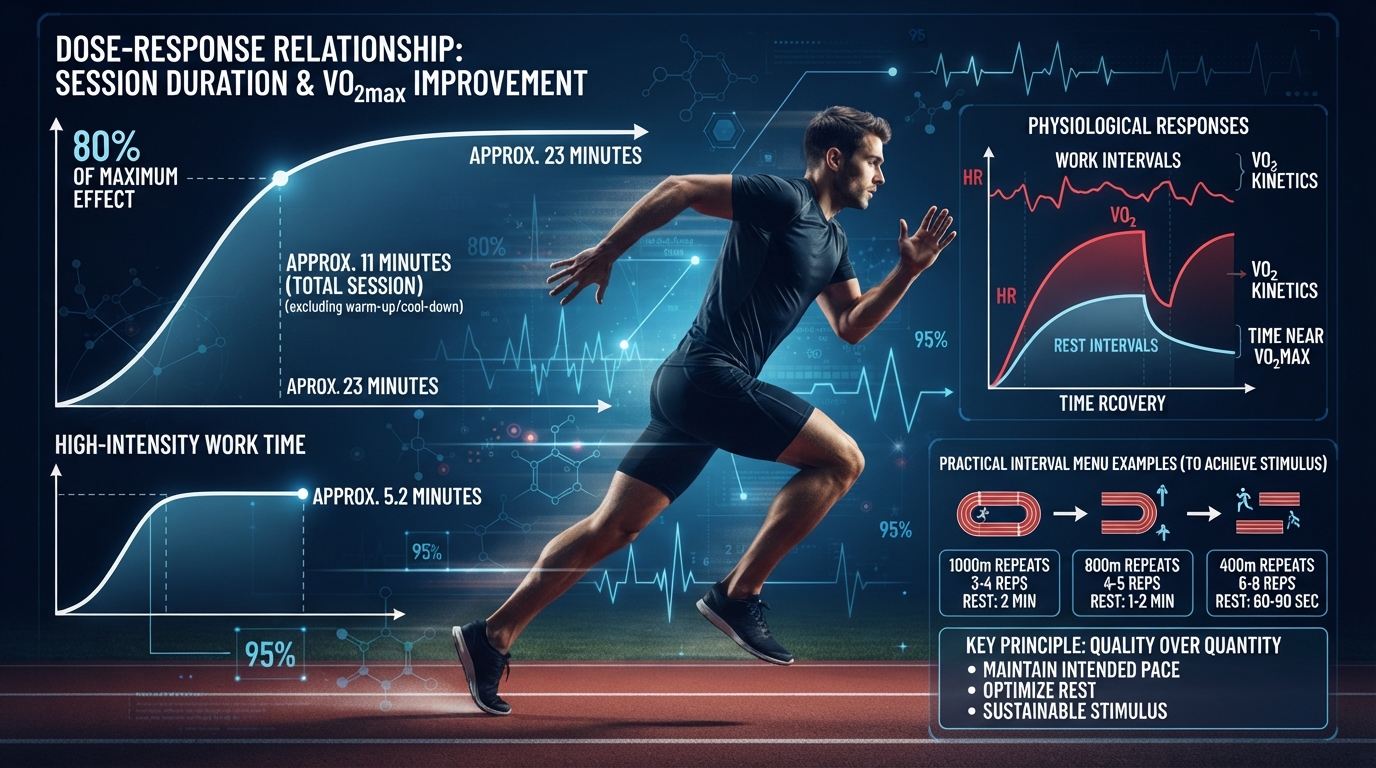
To verify why intervals can improve VO2max (maximal oxygen uptake) in a short time, we refer to recent findings in exercise physiology. A dose-response meta-analysis by Maturana et al. (2026) synthesized data from 69 randomized controlled trials involving a total of 2,387 participants, demonstrating a non-linear relationship between HIIT session duration and improvements in VO2max.
In the primary analysis of this study, exercise session duration was defined as “the time excluding warm-up and cool-down, including high-intensity intervals and the intervening recovery intervals.” Based on this model, it was estimated that 80% of the maximum possible improvement in VO2max can be achieved in approximately 11 minutes per session (ED80). Furthermore, the modeled response approached its maximum at approximately 23 minutes per session (ED100).
The study also analyzed moderate-intensity continuous training (MICT), estimating that 80% of the maximum improvement in VO2max is achieved at approximately 52 minutes per session. Comparing the model estimates suggests that interval training offers higher time efficiency regarding VO2max improvement. However, this is a comparison concerning the specific metric of VO2max. It does not indicate that intervals are universally superior across all general health benefits or as an optimal training method for individual athletes.
Moreover, the figure of approximately 52 minutes for MICT cannot be directly translated into meaning “you can just do LT runs or SST for 52 minutes.” MICT is a research exercise category and is not synonymous with LT runs or SST. Because LT and SST are generally performed at higher intensities than MICT, the 52-minute estimate cannot be applied directly.
It is also important to note that these times are relative to the estimated maximum effect for each exercise modality. They do not show that performing intervals for about 11 minutes produces the same absolute magnitude of VO2max improvement as performing MICT for about 52 minutes.
Furthermore, an important consideration is the uncertainty surrounding the approximately 11-minute figure. The 95% confidence interval for this estimate ranges widely from approximately 9.5 to 40.2 minutes, meaning it does not prescribe a universal, optimal duration for everyone.
Therefore, the figure of approximately 11 minutes should not be treated as a fixed answer that “doing just this amount is enough,” but rather as an indicator that increasing exercise duration does not result in benefits continuing to grow at the same proportional rate.
Chapter 2: How Do Heart Rate and Oxygen Uptake Change After Exercise Onset?
When applying the relationship between session duration and effects to actual training, physiological responses inside the body during exercise must be considered separately.
Running at a speed equivalent to VO2max does not mean oxygen uptake reaches VO2max the exact moment you start running.
Running speed represents the external exercise load applied to the body. In contrast, oxygen uptake is the physiological response generated inside the body against that load. Even when exercise intensity increases, it takes time for oxygen uptake to rise correspondingly.
Additionally, oxygen uptake does not rise instantaneously when exercise intensity increases. The time course of this response is described by VO2 kinetics, and its speed varies according to exercise intensity, prior exercise, and individual physiological characteristics. Therefore, a fixed delay of 90 or 120 seconds cannot simply be subtracted from every interval to calculate the time spent near VO2max.
A key point to note here is that heart rate responses and oxygen uptake responses are not entirely identical. For example, just because heart rate reaches a high level of 90% to 95% of maximum heart rate does not mean oxygen uptake (VO2) immediately matches that percentage. In everyday conversation, expressions like “heart rate reached the VO2max zone” are often used, but heart rate and oxygen uptake are distinct physiological indicators.
This is because prior exercise can speed VO2 kinetics during subsequent exercise, so the response during later repetitions may differ from that of the first repetition.
In other words, just because you ran 1000m in 4 minutes does not mean all 4 minutes were spent near VO2max. Conversely, from the second repetition onward, you may reach high oxygen uptake levels more quickly than in the first.
Understanding this difference reveals that intervals require considering not just “how many minutes you ran,” but a combination of interval length, rest, and repetition count.
Chapter 3: What Does Interval Rest Time Change?
In designing the structure of intervals, the role of recovery intervals (rest) between high-intensity bouts cannot be ignored.
Even with the exact same total duration of high-intensity exercise, the length of the work intervals and the configuration of recovery time alter the trajectory of oxygen uptake and the output that can be sustained in subsequent repetitions. Longer rest makes it easier to generate high power output in the next repetition. Conversely, designing shorter rest periods means oxygen uptake does not fully decline before entering the next high-intensity bout, which can sometimes help maintain a higher overall oxygen uptake throughout the session.
However, if the rest is too short, there is a risk that you will be unable to maintain the target pace in the later repetitions.
Here, another analysis from Maturana et al.’s meta-analysis is helpful. While the primary analysis used session duration including recovery time, a sensitivity analysis focused exclusively on “high-intensity exercise time” excluding recovery. The results estimated that 80% of the maximum effect was achieved at approximately 5.2 minutes of high-intensity work time.
While the approximately 11-minute figure includes “high-intensity exercise + rest,” the approximately 5.2-minute figure represents “high-intensity exercise alone.” Even within an 11-minute session, the actual volume of high-intensity work varies depending on the combination of work and rest.
Therefore, looking solely at the figure of “approximately 11 minutes” does not allow you to determine specific training menus, including rest periods.
Although no single optimal rest duration can be derived from these studies, for practical running sessions using 2- to 4-minute work bouts, a rest period of roughly half to the same duration as the work interval (around 1 to 2 minutes) can serve as a reasonable starting point.
For example:
- For a 2-minute work bout: about 1 minute of rest
- For a 3-minute work bout: 1 to 2 minutes of rest
- For a 4-minute work bout: around 2 minutes of rest
The key is not to make the rest as short as possible, but short enough to maintain the target pace in the next repetition.
Chapter 4: How Many Minutes Should You Spend Near VO2max?
In the context of endurance training, the amount of time spent in a high-level oxygen uptake region (time near VO2max) is often used as an indicator to evaluate the magnitude of the physiological stimulus.
However, the threshold used to evaluate time near VO2max varies across studies. Some use 90% or 95% of VO2max, while others target 80%. Therefore, when comparing time spent near VO2max across different studies, it is essential to check which threshold was adopted.
The 2026 systematic review and meta-analysis by Schoenmakers et al. analyzed time spent at or above 80% of VO2max. The findings showed that relatively long work intervals of 2 minutes or more elicited more time at or above VO2max than very short intervals of 30 seconds or less, or moderate-duration intervals between 30 seconds and 2 minutes.
Furthermore, when using longer work intervals, an increase in total session interval time tended to increase the time spent at or above 90% and 95% of VO2max.
This provides important information for planning actual interval training. That is, if the goal is to improve VO2max, simply repeating the shortest possible intervals in large quantities is not necessarily the most efficient approach. Performing repeated work intervals of 2 minutes or longer has a physiological rationale for accumulating time near VO2max.
However, caution is still required here. Just because you spend more time near VO2max does not automatically guarantee a greater improvement in VO2max weeks or months later. The dose-response relationship between time near VO2max and long-term training adaptation is not yet fully established.
Therefore, the following three elements must be considered separately:
- External Exercise Load: How many minutes you ran, how many repetitions you did, and at what pace.
- Internal Physiological Response: How heart rate and oxygen uptake changed and how long they stayed at high levels.
- Long-Term Training Adaptation: How VO2max or performance changed over weeks or months of consistent training.
These three are related, but they are not the same thing.
Chapter 5: So, How Many Repetitions Should Runners Do?
This brings us to the question runners care about most: How many 1000m repeats? How many 400m repeats? How long should the rest be?
Research papers do not provide a single definitive answer like “1000m x 4 repetitions is optimal” or “400m x 8 repetitions is optimal.” However, we can derive practical guidelines based on the research findings examined so far.
If the primary objective is to improve VO2max, I initially look at intervals consisting of multiple repetitions of 2 to 4-minute work bouts as a foundational structure. For practical running sessions, 2 to 4 minutes is one reasonable range to consider because using multi-minute work bouts makes it easier to secure time near VO2max and create the necessary stimulus across the interval session as a whole.
For rest, a practical guideline is to consider half to equal the duration of the work period.
| Interval Menu Example | Work Duration / Distance | Repetitions | Total High-Intensity Work Time | Rest Guideline | Total Work + Rest (Excluding Warm-up/Cool-down) |
|---|---|---|---|---|---|
| 2-min runs | 2 min | 5-6 | 10-12 min | 1 min | Approx. 15-18 min |
| 3-min runs | 3 min | 4-5 | 12-15 min | 1-2 min | Approx. 16-21 min |
| 4-min runs | 4 min | 3-4 | 12-16 min | Approx. 2 min | Approx. 18-24 min |
| 400m | Approx. 90-110 sec | 6-8 | Approx. 9-15 min | 60-90 sec | Approx. 15-25 min |
| 800m | Approx. 3 min | 4-5 | Approx. 12-15 min | 1-2 min | Approx. 16-21 min |
| 1000m | Approx. 4 min | 3-4 | Approx. 12-16 min | Approx. 2 min | Approx. 18-24 min |
It is important to note that this table does not represent an “optimal menu” directly validated by research. Maturana et al.’s research demonstrated dose-responses when aggregating various interval protocols. Therefore, specific menus such as 1000m x 3-4 or 400m x 6-8 are not direct quotes of research data. Rather, they are practical guidelines translated into running terms based on session durations, physiological VO2 responses, and time near VO2max reported in the literature.
Thinking of 1000m as 3 to 4 Repetitions
For runners who complete 1000m in about 3 to 4 minutes, doing 1000m x 3-4 repetitions with around 2 minutes of rest can be used as a practical starting point for improving VO2max. Three repetitions yield about 9 to 12 minutes of high-intensity work, while four repetitions yield about 12 to 16 minutes.
At this point, you might wonder: “Why is this so much higher than the ED80 for high-intensity work time (approximately 5.2 minutes) estimated by the statistical model?” (Note: ED80 refers to the exercise dose estimated by the dose-response model to achieve 80% of the maximum predicted effect.)
The reason is that 5.2 minutes is the ED80 of high-intensity work time derived from a statistical model, not a proven optimal dose for performing three or four 1000m intervals. Furthermore, not every second of each 1000m repetition is spent near VO2max; the first repetition requires time for VO2 to rise, whereas subsequent repetitions may resume with elevated baseline oxygen uptake.
Therefore, choosing 3 to 4 repetitions is not a calculated value to secure exactly X minutes near VO2max, but rather a practical range to perform multiple multi-minute work bouts and secure sufficient overall stimulus for the session.
Thinking of 400m as 6 to 8 Repetitions
Short intervals like 400m can also improve VO2max. However, because each repetition is short, the interval may end before VO2 has fully risen. Consequently, when using 400m, aiming for 6 to 8 repetitions serves as a practical starting point.
For instance, running each repetition in 100 seconds yields 10 minutes of high-intensity work for 6 repetitions and about 13 minutes and 20 seconds for 8 repetitions. Setting the rest to 60 to 90 seconds ensures sufficient repetition volume while maintaining a reasonable pace in later reps.
However, running 400m excessively fast transforms the session from a VO2max-targeted interval into training dominated by anaerobic loads. Thus, the notion that “faster is always better for 400m” is incorrect.
Rest Should Not Simply Be as Short as Possible
Research cannot definitively state whether “1-minute rest is optimal” or “2-minute rest is optimal.” Even so, starting with 1 to 2 minutes of rest for 2-to-4-minute intervals aimed at VO2max is an easy-to-handle setting in practice.
For 2-minute work intervals, about 1 minute of rest; for 3 minutes, 1 to 2 minutes; for 4 minutes, around 2 minutes. The key is not to make rest as short as possible, but short enough to maintain the target pace across subsequent repetitions. That is the fundamental rule.
For example, if shortening rest from 60 seconds to 30 seconds causes a severe drop in pace during the later reps, that reduction holds little value. Conversely, taking a 2-minute rest to stably maintain the pace until the very end gives that 2-minute rest clear purpose.
Chapter 6: Does Increasing Repetitions Increase Benefits?
Another critical question arises here: If you can successfully complete 1000m x 3 repetitions, does increasing it to 4, 5, or 6 repetitions amplify the stimulus for VO2max?
Not necessarily.
Maturana et al.’s study indicates that the relationship between interval session duration and VO2max improvement is non-linear, with benefits plateauing as exercise duration increases. Moreover, if pace drops significantly in the latter half of a single session, simply adding more repetitions does not automatically increase the desired stimulus.
For example, if a runner capable of running 1000m in 4 minutes logs splits of:
4:00, 4:01, 4:03, 4:05
they secure a fairly uniform stimulus. On the other hand, if splits look like:
4:00, 4:02, 4:15, 4:30
then rather than forcing a 5th repetition, it is often more rational to slightly back off the initial pace or keep the total volume to 3-4 repetitions.
In interval training, whether you successfully maintained the target intensity to the end matters more than how many repetitions you completed. Therefore, rather than deciding on “definitely 5 repetitions” from the start, a sensible approach is to use session quality as a metric – starting with 3 repetitions as a baseline and adding a 4th only if feeling good.
Chapter 7: Ultimately, How Many Minutes Should You Do Intervals?
Summarizing the research examined so far leads to a straightforward conclusion.
In Maturana et al.’s 2026 meta-analysis, the interval session duration – excluding warm-up/cool-down, combining work and rest – was estimated to reach 80% of the model’s maximum effect at approximately 11 minutes (ED80). Meanwhile, high-intensity work time alone was estimated at approximately 5.2 minutes. Additionally, Schoenmakers et al.’s 2026 meta-analysis showed that intervals utilizing longer work bouts of 2 minutes or more elicited more time at or above VO2max than shorter work intervals of less than 2 minutes.
Applying this to running, interval training aimed at VO2max improvement uses multi-minute work bouts (2 to 4 minutes) repeated multiple times, paired with 1 to 2 minutes of rest as a realistic starting point. Specifically:
- 400m: approximately 6-8 reps, 60-90 sec rest
- 800m: approximately 4-5 reps, 1-2 min rest
- 1000m: approximately 3-4 reps, approximately 2 min rest
- 1200m: approximately 3 reps, approximately 2 min rest
However, this does not mean “this is the single optimal solution.” The key is not to directly convert the approximately 11-minute figure derived from research into a training menu. The approximately 11-minute mark is a statistical model session duration combining various interval protocols, which includes rest. In actual training, physiological stimuli vary depending on interval length, pace, rest, and repetition count.
For this reason, the practical approach in actual running shifts from “stop once you hit 11 minutes” to “organize a structure where multi-minute work bouts can be repeated multiple times without a major drop in pace.”
Another vital concept is distinguishing between “sufficient” and “maximum.” To improve VO2max, there is no need to maximize repetition volume until failure every single time. As research indicates, increasing exercise volume does not result in proportional gains. Rather, stopping once the necessary stimulus is secured and preserving capacity for subsequent training is often more rational from a weekly perspective.
The purpose of interval training is not to complete the maximum possible volume in a single session. It is about accumulating the necessary stimulus in the necessary amount and maintaining a state where consistency is preserved. The essence of “time efficiency” revealed by these studies lies right there.
References
- Maturana FM, Zadon NHA, Cocks M, Niess AM, Thijssen DHJ, Dawson EA. Optimising Exercise Prescription: A Meta-Analysis Examining the Dose Response of Exercise Duration on Cardiorespiratory Fitness Following HIIT and MICT. Sports Medicine. 2026. PMID: 42730846
- Schoenmakers P, Murray K, White J, Matta G, Bossi AH. Time spent at or near VO2max during high-intensity interval training: a systematic review and meta-analysis. BMC Sports Science, Medicine and Rehabilitation. 2026;18:358. PMID: 42237396
- Goulding RP, Burnley M, Wust RCI. How Priming Exercise Affects Oxygen Uptake Kinetics: From Underpinning Mechanisms to Endurance Performance. Sports Medicine. 2023;53(5):959-976. PMID: 37010782
これなら、VO2max、VO2、%、×、≥、V̇O₂などの特殊なUnicode・LaTeX表記を使わず、ASCII文字を中心にしています。WordPressのエディターに直接貼り付ける用途としてはこちらの方が安全です。
なお、PMIDのURLだけは通常のASCII文字なので問題ありません。

コメント