
What is the true essence of speed in middle- and long-distance running?
Many runners instinctively look to “increasing cadence” (step frequency) or “widening stride length” as the primary drivers of velocity. However, rigorous biomechanical measurement data reveals that the differences between elite athletes and trained runners go far beyond these simple outer-form variables.
Published in Scientific Reports in 2021 by a University of Michigan research team led by Geoffrey T. Burns, the study titled “Bouncing behavior of sub-four minute milers” provides a detailed comparative analysis of the running mechanics of elite runners capable of running a mile (1,609.34m) in under 4 minutes (average speeds exceeding 24.14 km/h) versus well-trained regional-level runners.
The significance of this study lies in its continuous measurement of approximately 3,500 steps per subject—totaling 70,812 steps—across 10 speed conditions, ranging from 12 to 25 km/h for the elite group and from 10 to 23 km/h for the trained group. It used a spring-mass model to analyze the global mechanical behavior of the body during running.
In this article, we break down these findings into four distinct layers: objective facts directly proven by the study, biomechanical interpretations derived from those facts, cautions for practical application, and how masters runners should interpret and translate these findings into their own training.
- Layer 1: Objective Facts Directly Proven by the Study
- [Key Differences in Measurement Parameters Between Groups (Burns et al., 2021)]
- 1. No Statistically Significant Differences in Stride Frequency or Stride Length
- 2. Group Differences and Speed Response in Leg Stiffness (k_leg)
- 3. Differences in Vertical Stiffness (k_vert) and Rate of Increase
- 4. Peak Vertical Ground Reaction Force (F_max) and Impact Angle (alpha)
- 5. Temporal Metrics (Contact Time and Flight Time)
- 6. Spatiotemporal and Mechanical Variability (CV)
- Layer 2: Logical Inferences Derived from the Facts (Comparison with General Theory)
- Layer 3: Boundaries and Cautions in Practical Application
- Layer 4: Translating These Findings for Masters Athletes
- Conclusion: The Essence of Speed Lies in Integrated Spring-Mass Control
- References
Layer 1: Objective Facts Directly Proven by the Study
First, let us organize the empirical results directly revealed through statistical analyses (such as linear mixed-effects models) in the paper.
The participants comprised two groups of men: 10 elite runners (mean 1,500 m personal best: 3:37.3), including Olympians and US national champions, and 10 well-trained control runners (mean 1,500 m personal best: 4:07.6). Kinematic (motion) and estimated kinetic (mechanical) parameters were measured while running on a treadmill across 10 speed conditions (ranging from 12 to 25 km/h for the elite group and from 10 to 23 km/h for the trained group).
[Key Differences in Measurement Parameters Between Groups (Burns et al., 2021)]
- Stride Frequency (SF) & Stride Length (SL): No statistically significant main effects (group differences) found between the groups.
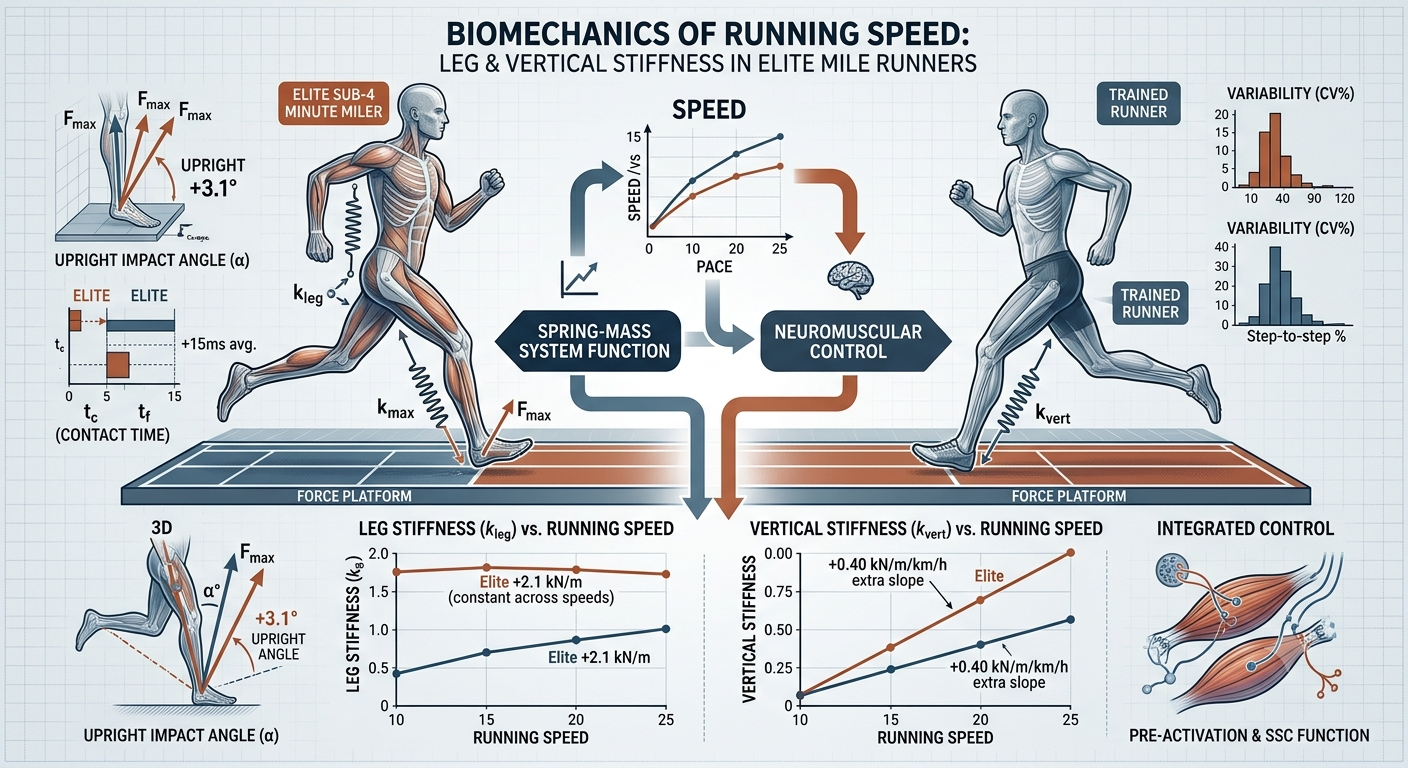
- Leg Stiffness (k_leg): Consistently higher in the elite group (+2.1 kN/m higher on average); no significant alteration across speeds (12–25 km/h for elites, 10–23 km/h for trained) in either cohort.
- Vertical Stiffness (k_vert): Higher in the elite group (+3.6 kN/m on average) and increased with speed in both groups, with the elite group showing a significantly greater rate of increase (+0.40 kN/m/km/h steeper slope).
- Estimated Peak Vertical Ground Reaction Force (F_max): 0.16 body weights (BW) higher in the elite group.
- Impact Angle (alpha): 3.1 degrees more vertical (steeper/more upright initial leg orientation) in the elite group.
- Flight Time (t_f): Average of 15 ms longer across all speeds in the elite group.
- Spatiotemporal and Mechanical Variability (CV): Significantly lower coefficients of variation in several specific spatiotemporal and spring-mass parameters for elite runners.
1. No Statistically Significant Differences in Stride Frequency or Stride Length
One of the key findings in this study is that neither stride frequency (SF) nor stride length (SL) showed a statistically significant main effect (group difference) between the elites and the trained runners.
Both groups increased their stride frequency and lengthened their stride as speed increased. However, the differences in stride frequency and stride length between the groups were not statistically significant. More broadly, the changes in spatiotemporal measures across speeds were generally less substantial in the elite runners.
2. Group Differences and Speed Response in Leg Stiffness (k_leg)
Regarding leg stiffness (k_leg), which represents the mechanical response of the entire lower limb during ground contact, the data revealed:
- The elite group exhibited an average +2.1 kN/m higher leg stiffness across all speeds compared to the trained group.
- Within the tested speed ranges (12 to 25 km/h for elites, 10 to 23 km/h for trained), neither cohort significantly altered their leg stiffness with speed.
In other words, the spring-like response characteristics of the leg remained relatively constant within each runner’s system from submaximal speeds to fast running.
3. Differences in Vertical Stiffness (k_vert) and Rate of Increase
Vertical stiffness (k_vert), which reflects the resistance of the whole-body center of mass to downward displacement, showed clear differences:
- The elite group demonstrated a higher vertical stiffness on average (+3.6 kN/m).
- Both groups increased their vertical stiffness as running speed rose. While the trained group increased stiffness at a rate of +1.62 kN/m per km/h, the elite group demonstrated an additional upward slope of +0.40 kN/m/km/h.
As speeds escalated, the elite runners demonstrated a stronger mechanical behavior that resisted downward displacement.
4. Peak Vertical Ground Reaction Force (F_max) and Impact Angle (alpha)
Using Morin’s simplified models based on running speed, contact time, and flight time, approximated mechanical parameters showed:
- The estimated peak vertical ground reaction force (F_max) was 0.16 BW (equivalent to 16% of body weight) higher in elite runners.
- The initial leg orientation angle at touchdown, known as the impact angle (alpha), estimated from leg length, running speed, and ground contact time, was 3.1 degrees more vertical (more upright) in the elite group.
5. Temporal Metrics (Contact Time and Flight Time)
- The elite group maintained a 15-millisecond (ms) longer flight time (t_f) on average across all speeds.
- The elite group demonstrated longer flight times across speeds, while their contact times changed less substantially as running speed increased compared to the trained runners.
6. Spatiotemporal and Mechanical Variability (CV)
Analyzing coefficients of variation (CV) to assess step-to-step consistency, the elite group showed significantly lower variability in several specific parameters:
- Flight time (t_f) CV
- Stride frequency (SF) CV
- Stride length (SL) CV
- Center of mass vertical displacement (delta y) CV
- Impact angle (alpha) CV
However, these differences were not observed across all measured parameters, and the effects of increasing speed varied depending on the parameter.
Layer 2: Logical Inferences Derived from the Facts (Comparison with General Theory)
What do these data tell us? Based on these empirical facts, let us examine potential mechanisms in light of general biomechanical and physiological theories.
1. Mechanical Control Beyond Stride Frequency and Stride Length
The lack of significant differences in stride frequency and stride length highlights a crucial realization: The essence of running speed lies less in how fast you move your legs and more in how your body coordinates and controls itself as a spring-mass system upon ground contact.
Elite runners set themselves apart not simply through stride frequency or stride length, but through the broader coordination and mechanical behavior of the spring-mass system during ground contact.
2. Geometrical Interpretation of a More Vertical Impact Angle (alpha)
The finding that elite runners’ impact angles are 3.1 degrees closer to vertical implies that their leg spring makes ground contact at a more upright orientation.
Geometrically, a steeper impact angle may be associated with shorter braking and propulsive phases. However, the extent to which this orientation reduces horizontal braking forces or improves forward propulsion cannot be determined from this study.
3. Alignment with General Knowledge of the Stretch-Shortening Cycle (SSC)
To explain how high leg stiffness (k_leg) and vertical stiffness (k_vert) are maintained, we can look to the general exercise physiology theory of the stretch-shortening cycle (SSC) within the musculo-tendinous unit.
During the stretch-shortening cycle, muscle-tendon units undergo controlled lengthening and shortening. Elastic energy can be stored in tendinous and other connective tissues during the loading phase and subsequently returned during propulsion. The extent of this storage and return depends on the interaction of muscle activity, tendon properties, and joint mechanics. (Note: Burns et al. did not directly measure muscle activation via EMG or tendon elongation.)
4. What Low Variability Implies
The fact that flight time and impact angle variability (CV) remained lower in certain parameters for elites reflects more consistent neuromuscular control. However, this study did not directly examine fatigue or determine whether lower variability reduces energy loss.
Layer 3: Boundaries and Cautions in Practical Application
When translating scientific findings into coaching or training practice, maintaining a clear boundary between proven facts and logical speculation is vital.
1. Limitations of Cross-Sectional Studies and Causality
This study is a cross-sectional observational comparison between elite and trained runners at a single point in time.
Therefore, this paper does not prove causality—it does not prove whether elite runners are fast because they possess high leg stiffness, or if high leg stiffness is simply the long-term adaptation resulting from years of rigorous elite training.
Attempting to artificially increase leg stiffness or maintain a rigid posture without adequate conditioning may alter how impact loads are distributed across muscles, tendons, and joints. This study, however, did not examine injury risk.
2. Accurate Understanding of Unmeasured Parameters (Running Economy)
The primary focus of Bouncing behavior of sub-four minute milers is the mechanical analysis of bouncing behavior.
Oxygen uptake (VO2) and metabolic energy expenditure were not measured in this study. Consequently, it is academically inaccurate to claim that this paper proved a direct link between leg stiffness and running economy.
3. A Warning Against Imitating the “Bouncing” Appearance
Elite runners demonstrated high stiffness and long flight times even at their lower submaximal speeds. However, this does not mean elites are consciously trying to bounce.
Rather, their superior physical capabilities, forged through years of long-term adaptation, naturally manifest as these mechanical dynamics. Amateur runners who attempt to copy the superficial appearance of a “bouncing stride” without the underlying physical conditioning may increase unnecessary vertical oscillation.
Layer 4: Translating These Findings for Masters Athletes
How should masters runners in their 40s, 50s, 60s, and beyond approach this concept of the “spring”?
The essential takeaway from this study is not simply to “make your legs stiffer.”
When contextualized for a masters runner, the true priority is understanding how to maintain and foster the body’s ability to react correctly as a spring without breaking down, while acknowledging age-related physical shifts.
1. Not “Stiff Legs,” but “Legs That Can React When Needed”
First, we must clarify terminology.
Leg stiffness is not about turning your legs into rigid iron bars. It is an integrated mechanical response property of the entire body system involving muscles, tendons, joints, and the nervous system.
What a masters athlete needs is not a permanently locked leg, but “legs that can deploy the exact right amount of stiffness at the exact right moment”—a responsive leg.
2. Paying Attention to Age-Related Shifts in Mechanics
When evaluating performance decline, many runners focus heavily on VO2 max or muscle mass.
However, running is not sustained by aerobic capacity alone. If ground contact involves greater joint flexion or prolonged contact times, the muscular and mechanical demands of maintaining a given running speed may change. These changes could increase the effort required to maintain running mechanics, although this study did not directly measure such age-related changes or their energetic cost.
3. Integrating Strength, Neuromuscular Function, and Elasticity
How should masters condition their bodies? The key lies in integrating Strength x Neuromuscular Function x Elastic Capability.
For masters training, balancing the following elements according to age and recovery capacity is effective:
- Maintaining baseline maximum strength (e.g., via resistance training)
- Maintaining single-leg stability for posture and joint alignment
- Preserving inter-joint coordination across ankles, knees, and hips
- Providing appropriate mechanical stimuli to tendons and musculo-tendinous units
- Preserving brief, explosive force-production capabilities via the nervous system
4. Never Completely Abandon “Fast Movements”
A critical pitfall in training is the complete elimination of fast movements.
Fast, reactive stimuli—such as short strides, accelerations, and carefully managed low-intensity plyometrics—serve a purpose beyond merely chasing speed. They act as maintenance check-ups to remind the body how to react quickly.
Rather than chasing youthful training volumes, finding the Minimum Effective Dose (MED) to preserve neural and mechanical function is the wisdom of masters training.
5. The Philosophy of “Not Losing the Spring to Keep Running Longer”
The study by Burns et al. (2021) examined world-class elites running under 4-minute miles. Yet, the framework of the spring-mass model offers profound insight for masters athletes.
The goal for a masters runner in their 40s, 50s, or 60s is not to artificially reclaim a 20-year-old body, but to maximize the preservation of mechanical function and robust system integrity within their current physiological reality.
For a masters runner, strengthening the spring is not about “brute-force training to chase velocity,” but rather:Ensuring you do not lose your spring’s reactive capacity, so you can keep running for a lifetime.
Conclusion: The Essence of Speed Lies in Integrated Spring-Mass Control
The research by Burns et al. (2021) visualized the running mechanics of Sub-4 milers through the lens of a spring-mass model.
- Under the study’s conditions, performance differences between elites and trained runners did not manifest in raw stride frequency or stride length numbers.
- The elite group generally demonstrated longer flight phases, greater leg and vertical stiffness, and higher estimated vertical forces.
- Elite runners exhibited a more vertical, upright impact angle.
- Elites maintained longer flight times and lower variability in specific spatiotemporal and spring-mass parameters.
When translating these scientific insights into a masters context, a fundamental question emerges: “How can runners in their 40s, 50s, and 60s maintain a physical system that efficiently absorbs ground forces and rebounds into the next stride?”
Running performance is not sustained by cardiopulmonary capacity and muscle mass alone. It is governed by an integrated mechanical system—how the body receives, deforms, and rebounds against ground forces with every footstrike.
It is not about locking your legs harder. It is not about awkwardly forcing yourself to bounce higher.
It is about safely and sustainably preserving the biological capacity to deploy the right stiffness at the exact right moment for as long as possible.
That may well be the ultimate key to transforming scientific evidence into running wisdom and preserving your running life for decades to come.
References
- Burns GT, Gonzalez R, Zendler JM, Zernicke RF. (2021). Bouncing behavior of sub-four minute milers. Scientific Reports, 11, 10501. PubMed (PMID: 34006954)
- McMahon TA, Cheng GC. (1990). The mechanics of running: how does stiffness couple with speed? Journal of Biomechanics, 23(Suppl 1), 65–78. PubMed (PMID: 2081746)
- Morin JB, Dalleau G, Kyröläinen H, Jeannin T, Belli A. (2005). A simple method for measuring stiffness during running. Journal of Applied Biomechanics, 21(2), 167–180. PubMed (PMID: 16082017)
- Cavagna GA, Saibene FP, Margaria R. (1964). Mechanical work in running. Journal of Applied Physiology, 19(2), 249–256. PubMed (PMID: 14155290)
- Saunders PU, Pyne DB, Telford RD, Hawley JA. (2004). Factors affecting running economy in trained distance runners. Sports Medicine, 34(7), 465–485. PubMed (PMID: 15233599)
コメント