
“The more you do, the stronger you get.” This is an approach that almost everyone who takes training seriously has believed at least once. Increase practice volume, perform more sets, and push yourself harder. The idea that accumulating more work leads directly to progress is straightforward and widely accepted.
However, is this approach always correct? A 2026 study published in the International Journal of Exercise Science (Calandrini et al., 2026) presents quiet yet undeniable data addressing this exact question.
This study demonstrated that in resistance training accompanied by high effort levels, increasing training volume does not necessarily translate into improved performance. There is often a noticeable gap between what we refer to as a “stimulus” and the actual “adaptation” the body executes.
1. What Did This Study Investigate?
The research team focused on the effects of different training volumes in High-Intensity Resistance Training (HIRT) on muscle performance and blood-derived biochemical markers.
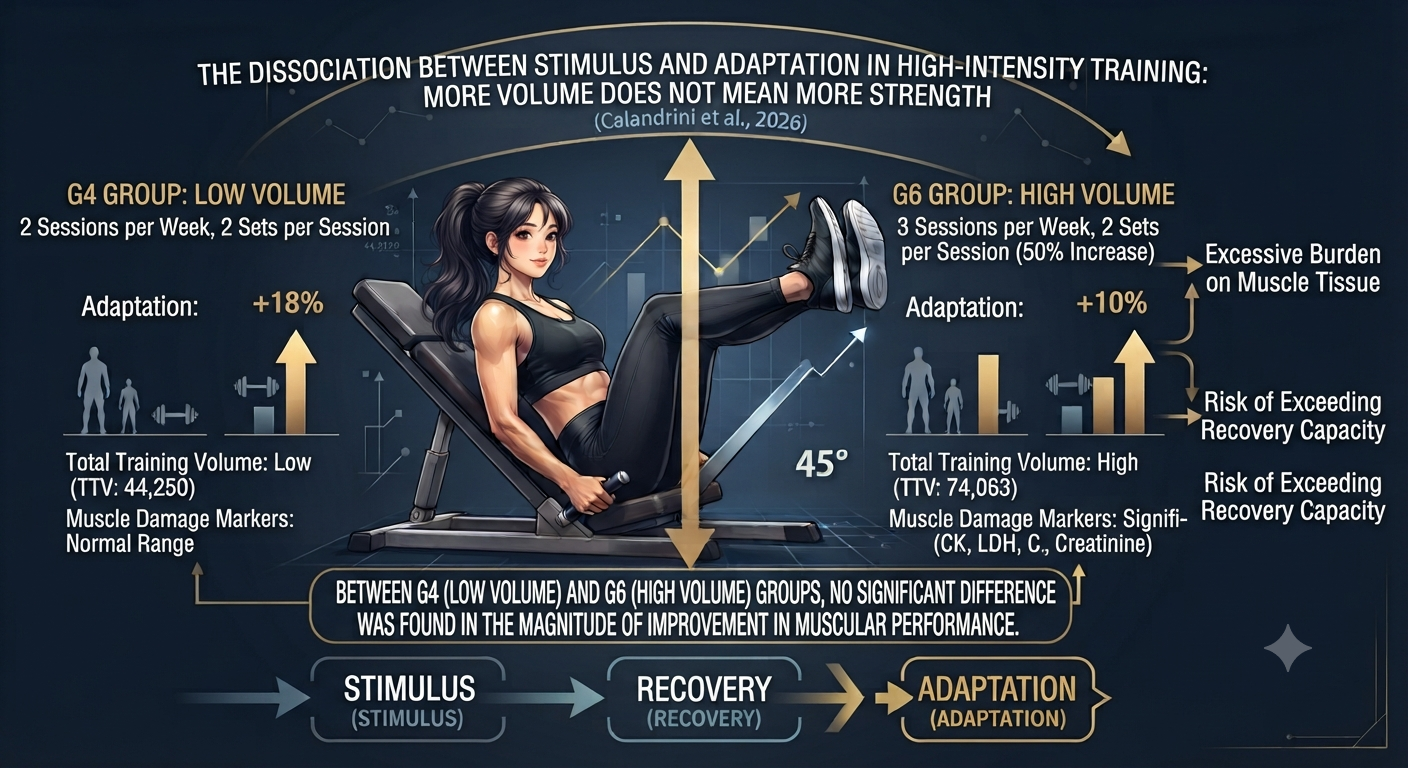
The study initially enrolled 36 volunteers, of whom 30 (14 men and 16 women) completed the intervention and were included in the final analysis. The participants were recreationally trained young adults aged 18 to 30 years, with a mean age of 21.7 ± 1.8 years. They were randomly allocated into two groups for a 4-week intervention:
・G4 Group (Low-Volume Group): 4 weekly sets per muscle group (2 sets per session, 2 sessions per week) ・G6 Group (High-Volume Group): 6 weekly sets per muscle group (2 sets per session, 3 sessions per week)
Simply comparing the two, the G6 group performed 50% more weekly sets. When calculating the Total Training Volume (TTV) over the 4-week intervention, the G4 group accumulated approximately 44,250 arbitrary units (a.u.), whereas the G6 group reached approximately 74,063 a.u. This represents an approximately 67% greater total training volume in G6 compared with G4.
However, the crucial point here is that this was not conventional resistance training. The HIRT protocol applied was a high-effort structure demanding maximum exertion:
・Load set at 85% 1RM ・Perform repetitions to Momentary Muscular Failure (MMF) (initially 6 reps) ・Rest for 20 seconds, then perform repetitions to failure again (3 reps) ・Rest for another 20 seconds, and perform repetitions to failure once more (3 reps) ・Rest for 2 minutes and 30 seconds, then repeat this entire sequence a second time
The exercise selection was limited to multi-joint movements (45º leg press, bench press, and seated row). Therefore, a single “set” in this study was not a lightweight set just going through the motions, but a heavy protocol combining high load with extremely short rest intervals taken to momentary muscular failure.
2. Results: Doing More Didn’t Make Them Stronger
How did the performance of both groups change after the 4-week intervention? For metrics such as bench press 1RM, leg press 1RM, and drop jump height, significant improvements over time (main effects) were confirmed.
However, here lies the core finding: Even though the G6 group completed 50% more weekly sets and substantially higher total training volume, it did not achieve greater improvements in muscle performance than the G4 group. Both groups improved over the 4-week intervention, but the additional training volume did not produce a measurable performance advantage.
On the other hand, differences were observed in internal physiological responses. Blood analyses revealed that the G6 group exhibited significantly greater changes in the following markers compared to the G4 group:
・Creatine Kinase (CK) ・Lactate Dehydrogenase (LDH) ・Creatinine
These are blood-derived markers that can provide information about physiological responses to exercise, although they are not specific indicators of muscle damage. Creatine kinase (CK) is commonly used as a marker of muscle damage, while lactate dehydrogenase (LDH) is a less specific marker of tissue damage. Creatinine is influenced by factors such as muscle metabolism, muscle mass, hydration, and kidney function.
The G6 group showed significantly greater changes in CK, LDH, and creatinine compared with the G4 group. These findings suggest a greater physiological response to the higher training volume, although the markers alone cannot establish the extent of actual muscle damage or the quality of recovery.
3. How to Interpret the Disconnection Between “Stimulus” and “Adaptation”
Scientific caution is required here. An increase in CK, LDH, or creatinine does not automatically imply that the body was “broken down,” that recovery failed, or that overtraining occurred. Fluctuations in biochemical markers merely reflect tissue strain, cell membrane permeability changes, or individual variations, and do not directly dictate long-term training adaptation.
Rather, the important insight provided by this study is the disconnect itself: greater changes in blood-derived markers associated with muscle damage were observed in the higher-volume group, yet these changes were not accompanied by greater improvements in physical performance compared with the lower-volume group.
In other words, providing a larger stimulus to the body is not synonymous with gaining a larger adaptation.
Why didn’t increasing volume lead to enhanced performance? However, this does not mean that training volume is irrelevant. Previous research has shown that the relationship between training volume and adaptation can differ depending on the outcome being measured. For example, Schoenfeld et al. (2019) found that higher training volumes produced greater increases in muscle hypertrophy at several measured sites in resistance-trained men, while strength gains did not differ significantly between groups.
Similarly, a systematic review and meta-analysis by Grgic et al. (2022) found no significant overall advantage of training to momentary failure over non-failure training for either strength or hypertrophy. These findings suggest that training volume and effort intensity should be considered together rather than treated as independent variables.
When every set is taken to MMF, imposing a high load on the neuromuscular and metabolic systems as in HIRT, the dynamics change. When the stress per set is substantial, simply adding more sets is less likely to produce extra progress and more likely to accumulate unnecessary strain on tissues beyond what is required for optimal signaling. In high-effort training, the recovery time needed following the stimulus must be carefully factored into the training design alongside the stimulus itself.
That said, it would also be incorrect to jump to the extreme conclusion that “less resistance training is always better.” The authors themselves caution against extrapolating these findings to other populations, such as bodybuilders. They also acknowledge that both training conditions could be considered low-volume protocols when compared with conventional resistance training, and that even higher training volumes may produce different responses.
The key is not adopting a dogma that “less is better,” but recognizing that training volume has an optimal range defined by purpose, effort intensity, and recovery capacity. More is not inherently better, nor is less inherently better. Identifying the volume your body can process into adaptation is what truly matters.
4. The “Necessary and Sufficient” Mindset for Endurance Athletes
The insights gained in this laboratory setting might seem confined to resistance training with barbells and machines. However, the underlying structure offers valuable perspectives for designing endurance training in running or triathlon, even though it belongs to a different training domain.
Those engaged in endurance sports are particularly prone to the temptation of “the more I do, the faster I’ll get.” Increasing weekly mileage, adding more high-intensity interval reps, or extending tempo runs—or layering additional weight training sets on top—often stems from volume-centric thinking: “If I push this hard, my race times will surely improve.”
Yet, the essence of endurance training is likewise not merely accumulating volume. Stimulus -> Recovery -> Adaptation In this sequential process, identifying where the boundary lies—the point up to which the body can digest and convert work into adaptation—is the core of training design.
No matter how many high-intensity sessions or long runs are completed, if the workload exceeds recovery capacity, performance gains stagnate while fatigue accumulates. Although this study examined resistance training rather than endurance training, the underlying principle may also be relevant to endurance athletes. Increasing training volume can increase physiological stress without necessarily producing proportional improvements in performance. However, this study does not directly establish how training volume should be prescribed for endurance athletes.
This brings to mind concepts of “sustainability” and “avoiding excessive stress” discussed in modern endurance sports. For instance, the approach conceptualized by Marius Bakken underlying the Norwegian Method—strictly respecting the “Golden Zone” and focusing not on pushing to exhaustion, but on “maintaining a state where high-quality stimuli can be repeatedly accumulated”—shares a common philosophy. While this paper does not directly prove the Norwegian Method or endurance training theories, it provides a lens to ask:
・Are you sacrificing the balance between recovery and adaptation in pursuit of maximum stimulus? ・Has increasing sets or mileage become an end in itself? ・Where is the “necessary and sufficient volume” that your body can actually absorb?
This research provides us with a valuable perspective to reflect on these questions.
5. Conclusion
“I ran 30 km today.” “I completed 12 interval reps today.” “I ran 150 km this week.” “I lifted to failure.” ──These are all records of stimuli. What we ultimately want to know, however, is: “What did the body actually adapt to as a result of that stimulus?”
The following is a simplified conceptual model, not a representation of the actual data from the study.
・A: Stimulus 100 / Recovery 100 / Adaptation 80 ・B: Stimulus 150 / Recovery 100 / Adaptation 80
Option B may offer a sense of accomplishment from having “done 150.” However, while the adaptation achieved by the body is identical to Option A, Option B carries a higher risk of increasing fatigue and requiring extended recovery. If a stimulus of 100 yields an adaptation of 80, that is entirely sufficient.
Training is not a game of maximizing the stimulus.Rather,it is a game of maximizing the adaptation.
Training, after all, may be about finding the optimal threshold. However, that threshold refers not to the amount of “stimulus given to the body,” but to the amount of “stimulus the body can digest into adaptation.”
Doing more does not automatically mean gaining more. It is neither about doing as much as possible nor as little as possible, but finding the optimal dose the body can convert into adaptation. Rather than focusing solely on how hard you pushed yourself in the past, cultivating the judgment to identify the boundary of “necessary and sufficient stimulus” that leads to sustainable adaptation will serve as an essential compass for long-term training.
References
- Calandrini A, Penna EM, Franco ECS, Martins Filho AJ, Souza D, Ribeiro M, Gentil P, Coswig VS. Effects of High-Intensity Resistance Training Volume on Muscle Performance and Blood-derived Markers in Recreationally Trained Subjects. International Journal of Exercise Science. 2026;19(6):6006. https://doi.org/10.70252/IJES2026606
- Schoenfeld BJ, Contreras B, Krieger J, Grgic J, Delcastillo K, Belliard R, Alto A. Resistance Training Volume Enhances Muscle Hypertrophy but Not Strength in Trained Men. Medicine & Science in Sports & Exercise. 2019;51(1):94–103. PMID: 30153194
- Grgic J, Schoenfeld BJ, Orazem J, Sabol F. Effects of resistance training performed to repetition failure or non-failure on muscular strength and hypertrophy: A systematic review and meta-analysis. Journal of Sport and Health Science. 2022;11(2):202–211. PMID: 33497853
コメント