
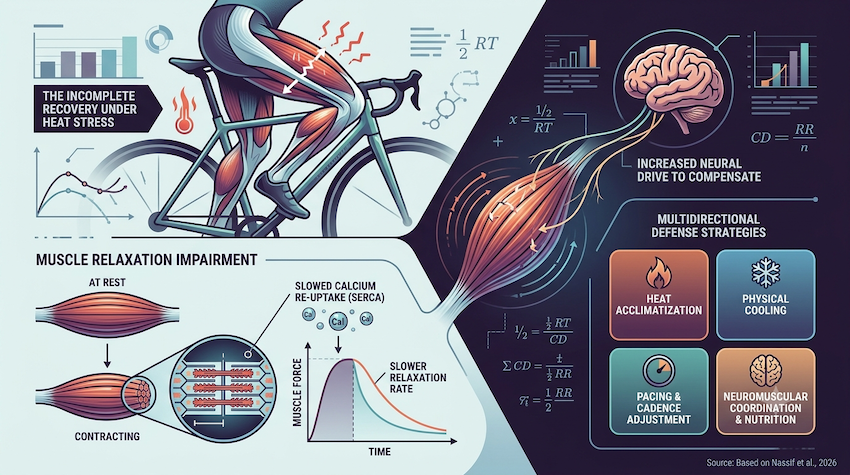
Fueling and hydration were perfect… Electrolytes were properly dissolved in the bottle. Energy gels were consumed every 30 minutes according to plan. There were no signs of bonking (glycogen depletion). Yet, during the second half of a summer race or the final stretch of a long ride, the legs feel completely “sold out”—becoming so heavy that no matter how hard you try to push the pedals, you simply can’t.
“Was my fueling timing off?” “Did I not consume enough gel?” Many endurance athletes have likely found themselves questioning their nutrition plan in this exact way.
However, what occurs inside the body during the second half of a summer race may not be fully explained by simple fuel depletion (lack of energy) or dehydration alone. What may be lost is not simply energy, but rather the “smoothness of movement.” In other words:
It is not that you have lost the power to push down on the pedal. It is that after pushing, your leg cannot recover and return quickly.
Of course, this does not mean that “all summer slowdowns are caused by reduced muscle relaxation.” Prolonged exercise under heat involves multiple interacting factors, including dehydration, elevated core body temperature, carbohydrate utilization, cardiovascular strain, and central nervous system fatigue.
Among these, this article focuses on a capacity that has previously received little attention: “the ability of a muscle to relax quickly after contracting.”
- “Another Type of Fatigue” Unexplained by Fueling Alone
- Slower Muscle Relaxation During Prolonged Exercise in the Heat
- Fatigue Is Not Just “Inability to Produce Force”
- Why Do Muscles Struggle to “Return”?
- This Does Not Mean “Fueling Is Pointless”
- What Does This Mean for Masters Athletes?
- Strategies to Prevent Late-Race Slowdowns in Summer
- Summary — Generating Force Is Not a Muscle’s Only Job
- References
“Another Type of Fatigue” Unexplained by Fueling Alone
In recent years, sports nutrition has heavily emphasized “what, when, and how much to consume.”
This is undoubtedly important. During prolonged exercise, supplementing carbohydrates, fluids, and sodium significantly impacts performance. However, nutrition and hydration cannot fully reverse every single change occurring within the body.
For instance, under heat stress, blood flow to the skin increases to regulate body temperature, putting greater strain on the cardiovascular system. At the same time, prolonged exertion places a heavy burden on the muscles themselves. Muscles do not merely need to “exert force”; they must also release that force at the appropriate timing.
From this perspective, fatigue under heat stress can be divided into two main aspects:
Aspects Supported by Nutrition and Hydration
- Addressing fluid loss from sweating through fluid and sodium intake.
- Sustaining energy supply during exercise through carbohydrate intake.
- Preventing performance drops caused by hypoglycemia or severe dehydration through proper fueling.
Aspects That Cannot Be Directly Solved by Fueling Alone
- Functional changes within the muscles themselves caused by high body temperature and prolonged exertion.
- Neuromuscular strain resulting from repeated muscle contraction and relaxation cycles.
- Changes in mechanisms involved in contraction and relaxation, such as intracellular calcium regulation.
In short, “being properly fueled” does not automatically mean “muscles will continue to function normally until the very end.”
Slower Muscle Relaxation During Prolonged Exercise in the Heat
A study published in 2026 investigated muscle contraction characteristics following a 60 km self-paced cycling trial in a hot environment.
The subjects were 10 well-trained male cyclists. They completed a 60 km cycling bout in a 32°C environment, with neuromuscular function measured before and after the ride.
The study compared five different conditions: a 6% carbohydrate beverage, a carbohydrate-free placebo beverage, carbohydrate capsules, placebo capsules, and plain water. This design aimed to isolate the effects of carbohydrate ingestion as well as the oral sensing of carbohydrates.
Measurements included maximal voluntary contraction (MVC), voluntary activation (VA), M-wave, and electrically stimulated muscle twitch characteristics.
This gets a bit technical. If you feel confused by the terminology, there is no need to memorize these specific terms. The crucial takeaway for this article is that researchers evaluated how quickly muscles could release tension after contracting.
The study found that after exercise, muscle relaxation rates decreased and contraction durations lengthened across multiple conditions. Meanwhile, carbohydrate intake failed to produce any clear suppressing effect on these changes.
This is the central point:
Even with carbohydrate intake, changes related to post-exercise muscle relaxation were not significantly prevented compared to placebo conditions.
However, this does not mean “carbohydrate supplementation is useless.”
The study found no statistically significant differences in overall performance across conditions, meaning these muscle-level changes do not necessarily equate to immediate racing failure. The researchers concluded that the observed impairment primarily reflected exercise and heat load rather than carbohydrate availability or the way carbohydrate was delivered.
Fatigue Is Not Just “Inability to Produce Force”
When thinking of muscle fatigue, we often picture “a drop in maximal strength” or “being unable to push hard.” However, in actual movement, relaxing tension at the right moment is just as crucial as generating force.
Consider pedaling: while the right leg forcefully pushes down on the pedal, unnecessary muscle tension on the left side should be minimized as much as possible.
The same applies to running: after the foot strikes the ground and generates power, the engaged muscles must relax at the proper timing to transition into the next stride. A muscle cannot function efficiently through “contraction” alone.
Contract. Then, relax at the required moment.
It is the repetition of this precise switching that allows for smooth movement.
However, when fatigue slows down relaxation, muscles may remain excessively tense for longer than necessary. Consequently, switching to the next movement becomes less smooth, which may lead to subjective sensations like “heavy legs” or “poor cadence/pedal stroke fluidity.”
Caution is needed here as well. This study did not directly measure the causes of “heavy legs” during an actual race.
What the study found was a change in indicators related to muscle relaxation after prolonged exercise in the heat. While we can draw logical connections to real-world pedaling or running sensations, we cannot definitively conclude that “the sole cause of impaired leg turnover is reduced muscle relaxation.”
Why Do Muscles Struggle to “Return”?
Calcium ions play a vital role in muscle contraction and relaxation. When a muscle contracts, calcium ions are released from the sarcoplasmic reticulum. These calcium ions act on the contractile apparatus of the myofibrils, enabling the muscle to exert force.
For the muscle to relax, those released calcium ions must be pumped back into the sarcoplasmic reticulum. Mechanisms such as SERCA (sarcoplasmic/endoplasmic reticulum Ca²⁺-ATPase) are responsible for this calcium reuptake.
During prolonged exercise in hot environments, factors like elevated muscle temperature and altered metabolic conditions are known to place strain on contraction and relaxation mechanisms. Heat-stress-induced changes in sarcoplasmic reticulum calcium handling may contribute to this decline in muscle function.
Again, we must be careful not to assume that “a decline in SERCA function was directly proven in this study.” The study directly measured parameters such as muscle relaxation rate and contraction duration.
While alterations in calcium handling are a plausible physiological explanation behind these changes, this mechanism was inferred from broader physiological principles rather than directly measured in this specific experiment. Keeping this distinction in mind is important.
This Does Not Mean “Fueling Is Pointless”
Reading this, some might wonder, “Does this mean taking in carbohydrates is meaningless?”
Of course not. Carbohydrate supplementation during prolonged exercise serves the critical role of energy provision. The study highlighted a much more specific point:
Carbohydrate intake may not clearly prevent the post-exercise changes in muscle relaxation that occur after prolonged exercise in the heat.
That is all. In other words, we need to separate problems that can be addressed by nutrition from those that cannot be solved by nutrition alone. This is a surprisingly valuable perspective when planning summer race strategies.
What Does This Mean for Masters Athletes?
How should masters athletes in their 40s, 50s, or 60s interpret these findings? This requires careful consideration.
The subjects in this study were young male cyclists, and the research did not compare younger individuals with older athletes. Therefore, one cannot directly conclude from this study that “this decline in relaxation worsens with age.”
On the other hand, existing research demonstrates that aging brings changes in muscle mass, muscle fiber composition, neuromuscular function, and calcium handling. Rather than directly applying these findings to masters athletes as an absolute rule, it is more appropriate to view it as a reminder to:
“Pay greater attention than before to functional changes in muscles caused by heat and prolonged exertion.”
If you experience late-race leg heaviness in summer that never bothered you when you were younger, or if your movement deteriorates late in an event despite maintaining your usual fueling strategy, avoid trying to explain it solely by “insufficient carbs” or “insufficient hydration.”
The heat itself may be altering how your body moves.
Strategies to Prevent Late-Race Slowdowns in Summer
What practical steps can be taken in training and racing?
1. Utilize Heat Acclimatization
Adapting your body to the heat is fundamental preparation for summer racing. Heat acclimatization improves thermoregulatory responses—such as sweating and cardiovascular function—making it easier to reduce thermal strain at a given workload. However, it cannot be claimed that heat acclimatization will completely prevent the muscle relaxation changes observed in this study. It should be viewed as a way to build overall resilience to high temperatures.
2. Implement In-Race Cooling Techniques
In hot conditions, removing heat from the body is just as vital as putting nutrients into it. Utilize various cooling methods depending on the situation, such as cold drinks, ice slurries, cooling vests, or pouring water over yourself. Especially in severe heat, cooling and fueling should not be treated as isolated tasks, but integrated into a combined strategy.
3. Adjust Pace According to the Heat
On hot days, stubbornly chasing fixed target numbers—thinking “I must hold this exact power output to the end”—is risky. Monitor your heart rate, RPE (rate of perceived exertion), thermal sensation, and leg feel, adjusting your pace early.
When legs feel heavy or turnover suffers, avoid trying to muscle through it with pure force. On a bike, shift to lighter gears to maintain cadence; in running, ease off the pace slightly. In hot conditions, “preventing an excessive drop in pace” can often be more important than “refusing to drop pace at all.”
4. Do Not Stop Fueling
Lastly, reading this article should not lead to neglecting nutrition. Supplying carbohydrates, fluid, and sodium remains essential for supporting prolonged exertion.
This study suggested that “carbohydrate supplementation cannot prevent all forms of fatigue,” not that “carbohydrate intake is unnecessary.” Rather, approach your strategy with a two-pronged mindset:
- Execute nutrition and hydration properly as foundational support.
- Concurrently address heat stress that cannot be solved by fueling alone.
Summary — Generating Force Is Not a Muscle’s Only Job
When legs feel heavy during the second half of a midsummer race, we tend to attribute it entirely to “running out of gas” or “dehydration.” While these are crucial, research shows that prolonged exercise under heat affects not only a muscle’s ability to exert force, but also its capacity to relax and transition into the next movement.
The 2026 study demonstrated that after 60 km of cycling in 32°C conditions, muscle relaxation rates decreased and contraction durations lengthened—changes that were not clearly suppressed by a 6% carbohydrate solution.
This does not imply that “impaired relaxation is the sole cause of summer slowdowns.” Real-world racing involves a complex overlap of heat strain, exercise duration, energy availability, cardiovascular load, nervous system fatigue, and intrinsic muscle function.
That is why summer race preparation should look beyond “what to supplement” and also consider:
- “How to prevent excessive heat buildup in the body.”
- “How to sustainably manage pace without overexertion.”
- “What is required to maintain movement efficiency when fatigued.”
Muscles do not exist solely to generate force.
Contract. And relax when required.
Through this ongoing cycle, we turn pedals, strike the ground, and move forward into the next stride.
The next time you feel your legs “give out” late in a summer race, it may be worth considering the situation from a slightly different perspective—by turning your attention to the muscle’s “ability to return.”
References
- Nassif C, Cannon J, Marino FE. Skeletal muscle twitch relaxation kinetics following heat stress endurance: carbohydrate versus placebo. European Journal of Applied Physiology. 2026. (PubMed)
- Périard JD, Eijsvogels TMH, Daanen HAM. Exercise under heat stress: thermoregulation, hydration, performance implications, and mitigation strategies. Physiological Reviews. 2021. (Physiology Journals)
コメント