
- Key Takeaways (Read this if you’re in a hurry!)
- What Is VO2max, Really?
- Why a Big Engine Doesn’t Guarantee Running Speed
- Converting Numbers into Speed: The Concept of “vVO2max”
- Running Economy: The Question of Fuel Efficiency
- 💡 A Concrete Practical Approach to Developing the 5 Capacities
- 1. Simultaneous Neuromuscular & Fuel-Efficiency Development (“1+4 Jog” / “1+3 Jog”)
- 2. Linking vVO2max Directly to Economy (400m Short Intervals)
- 3. Elevating Lactate Clearance (Cruise Intervals)
- 4. Pure Neuromuscular Upgrades (Strides / Wind Sprints)
- 5. Hill Work for Neuromuscular Power & High-Cadence Mechanical Efficiency (Hill Sprints / Downhill Strides)
- LT1 (Lactate Threshold 1): The Aerobic Foundation Prioritized by Modern Elite Athletes
- Why Relying Solely on LT2 and High-Intensity Intervals Falls Short
- The Hidden Factor Behind Efficient Running: Neuromuscular Refinement
- Technical Perspective: Form Is Not About “Looking Pretty”
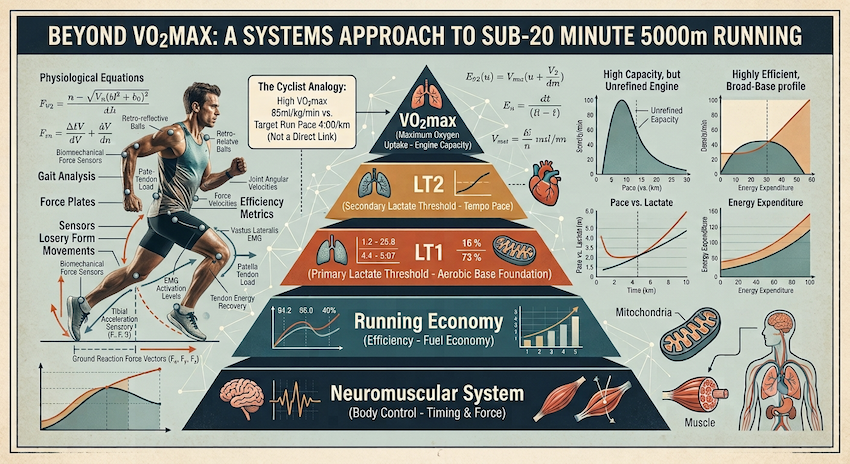
- The Capacity Pyramid for Breaking 20 Minutes in the 5000m
- [ Apex ] VO2max (Maximum Oxygen Uptake / Ceiling)
- vVO2max / LT2 (Velocity at VO2max / Race-Pace Ceiling)
- LT1 (Lactate Threshold 1 / Aerobic Base)
- Running Economy (Metabolic & Biomechanical Efficiency)
- Summary: Turning Aerobic Potential Into Actual Race Speed
Key Takeaways (Read this if you’re in a hurry!)
- To break 20 minutes in the 5000m (4:00/km pace), simply driving up your Maximum Oxygen Uptake (VO2max)—the “engine size”—through brutal, breath-sucking workouts is not enough.
- What truly matters is raising your “vVO2max” (velocity at VO2max)—the actual running speed your body can produce when operating at peak oxygen capacity.
- The true drivers of vVO2max are Running Economy (fuel efficiency and biomechanics) and Neuromuscular Coordination (motor control, impact tolerance, and elastic recoil).
- Modern endurance science emphasizes that elevating your LT1 (Lactate Threshold 1)—the boundary where running feels completely sustainable and comfortable—provides the solid aerobic foundation required for real-world racing speed.
- I am not writing this as an expert looking down from above, but as an athlete actively testing and validating this scientific hypothesis on my own body to break the 20-minute barrier.
If you find yourself thinking, “I’m pushing myself to the absolute limit every day, so why can’t I break 20 minutes?”, read on to discover the scientific reasons why—and how to fix it.
When runners hit a wall trying to break 20 minutes in the 5000m, the first solution that comes to mind is often “interval training to build cardiovascular fitness.” It is widely believed that gasping for air and pushing VO2max to its absolute ceiling is the ultimate requirement for running faster.
However, this conventional wisdom deserves a closer look.
If distance running performance were determined solely by VO2max numbers, elite athletes from other endurance sports would be able to step onto a track and instantly drop incredible times. Consider professional road cyclists or cross-country skiers.
Their measured VO2max values are among the highest in human sports. Yet, if they lace up a pair of running shoes, step onto a track, and attempt a 5000m, they cannot simply maintain 4:00/km pace and sub-20 effortlessly. Their cardiovascular system may have the massive capacity, but their musculoskeletal system is not yet adapted to the impact, stiffness, and elastic demands of running.
This points to a common blind spot for runners. In this article, we will examine the physiological and neuromuscular mechanisms behind running performance to take a step back and consider what is truly required to break 20 minutes in the 5000m.
As a runner currently pursuing a sub-20 5000m myself, the questions of whether a high VO2max alone guarantees speed and which capacities should take priority are not just theoretical—they are central to how I design my own daily training. This article synthesizes sports science literature with insights gained from my own ongoing trial and error.
What Is VO2max, Really?
To establish a baseline, let’s break down the basic physiological process of VO2max:
Inhaling oxygen from ambient air (Respiratory Function)
↓
Transporting oxygen through the bloodstream to muscles (Cardiovascular Function)
↓
Converting oxygen into energy within muscle cells (Skeletal Muscle Function)
Definition: VO2max represents the maximum volume of oxygen (in milliliters) that your body can transport and consume per kilogram of body weight per minute (ml/kg/min).
In automotive terms, VO2max is your engine displacement. A 3.0-liter engine has the potential to burn more fuel and generate more raw power than a 1.5-liter engine. A high VO2max provides a massive foundation for energy production.
However, having a large engine under the hood is one thing; navigating a complex racetrack quickly and efficiently is another. No matter how powerful the engine is, if the vehicle is overly heavy or the tires lack traction, lap times will not improve. A similar phenomenon occurs in human running.
Why a Big Engine Doesn’t Guarantee Running Speed
World-class cyclists offer a clear example of why raw engine size does not automatically translate into running performance.
Elite road cyclists often record VO2max values between 80 and 90 ml/kg/min—on par with world-class marathoners. If engine size alone dictated running speed, one might expect them to run at world-class levels instantly.
In reality, if they attempt a 5000m track run at 4:00/km pace, maintaining that speed proves surprisingly difficult. While their cardiovascular system has the capacity, their musculoskeletal system is not yet adapted to the impact, stiffness, and elastic demands of running. Muscular fatigue and mechanical breakdown set in rapidly.
Their physiology has been finely tuned to turn bicycle pedals efficiently, not to absorb ground impact and propel body weight forward on foot. Without the ability to transfer energy into forward movement without waste, high oxygen capacity cannot be converted into running velocity.
Converting Numbers into Speed: The Concept of “vVO2max”
To understand real-world race performance, we must introduce a more practical metric: vVO2max (velocity at VO2max).
While VO2max measures abstract oxygen volume, vVO2max represents the actual running speed (pace in min/km or km/h) achieved at the exact moment VO2max is reached.
Consider two runners with the exact same VO2max of 70 ml/kg/min:
- Runner A: Reaches VO2max (70) only after accelerating to a pace of 3:00/km.
- Runner B: Reaches VO2max (70) at a pace of 3:20/km.
Here, Runner A’s vVO2max is 3:00/km, while Runner B’s is 3:20/km. Despite having identical cardiovascular potential, Runner A demonstrates far greater running speed. Runner B possesses a strong engine but loses efficiency somewhere in the process of converting that energy into forward motion.
In a 5000m race, runners generally sustain an average pace equivalent to roughly 90% to 95%+ of their vVO2max. To cruise at 4:00/km for 5000m, you must not only raise your VO2max ceiling but also shift your vVO2max speed to the right (faster). If your vVO2max is only 3:55/km, sustaining 4:00/km for 5 kilometers is physiologically nearly impossible.
Running Economy: The Question of Fuel Efficiency
Why do two runners with the same VO2max display different vVO2max values? The answer lies in Running Economy.
Running Economy is the volume of oxygen (energy) required to run at a given submaximal velocity. It is your body’s fuel efficiency.
| Runner | Pace at the Same Oxygen Consumption (Same Perceived Effort) |
| Runner A (High Economy) | 4:00 / km (Sub-20 5000m Pace) |
| Runner B (Low Economy) | 4:30 / km (22:30 5000m Pace) |
Consuming the exact same amount of energy results in a 30-second-per-kilometer difference in speed. This gap in running economy directly dictates the difference in vVO2max.
Running Economy is shaped by a complex interplay of physiological and structural factors:
- Muscle Characteristics: Percentage of slow-twitch fibers and capillary density for oxygen delivery.
- Tendon Elasticity: The ability of tendons (like the Achilles) to store and release elastic energy like a spring.
- Biomechanical Efficiency: Form that eliminates wasted motion in lateral or vertical directions.
- Foot Strike & Alignment: Ground contact positioned directly beneath the center of mass to prevent braking.
- Core Stability & Posture: Structural strength that prevents energy leaks through torso oscillation.
- Ground Reaction Force: The skill of converting ground impact into forward propulsion.
Runner A utilizes ground reaction forces efficiently, requiring less oxygen to sustain higher speeds (vVO2max). Runner B loses energy with each footstrike, applying subtle brakes and relying on brute muscle force and respiratory effort to compensate. Without improving economy, driving up VO2max through hard workouts will still leave a runner stuck at the 20-minute barrier.
💡 A Concrete Practical Approach to Developing the 5 Capacities
While I am still working toward breaking 20 minutes in the 5000m myself, here are the specific workout examples I incorporate into my own daily training to target neuromuscular coordination, running economy, and vVO2max rather than simply running until exhaustion.
1. Simultaneous Neuromuscular & Fuel-Efficiency Development (“1+4 Jog” / “1+3 Jog”)
- Structure: 100m at target race pace (4:00/km) + 300m–400m recovery jog in a comfortable Zone 2 aerobic range, repeated continuously.
- Purpose: I call this approach the “1+4 Jog” (or 1+3 Jog) method. By keeping the fast segment short (100m), the brain and nervous system learn efficient biomechanics (center-of-mass transition and elastic recoil) at 4:00/km pace before heart rate spikes. The subsequent recovery jog keeps heart rate strictly within the Zone 2 aerobic window, expanding the aerobic base without accumulating fatigue.
2. Linking vVO2max Directly to Economy (400m Short Intervals)
- Structure: 400m in 96 seconds × 10–12 reps (Recovery: 200m jog or walk until heart rate settles).
- Purpose: Traditional 1000m intervals often cause late-set fatigue, leading to form breakdown and braking forces. Breaking the volume into 400m repetitions allows you to lock in 4:00/km pace with fresh mechanics and high economy, raising vVO2max without unnecessary strain.
3. Elevating Lactate Clearance (Cruise Intervals)
- Structure: 1000m × 4–5 reps at 4:15–4:20/km pace (Recovery: 1:00–1:30 standing or walking rest).
- Purpose: Running slightly slower than target race pace targets the zone just below rapid lactate accumulation. This raises lactate threshold (LT2) and cruising speed while avoiding heart rate spikes.
4. Pure Neuromuscular Upgrades (Strides / Wind Sprints)
- Structure: 100m × 3–5 reps at a smooth 3:45–3:50/km feel, performed at the end of an easy jog.
- Purpose: Placed after easy runs without taxing the cardiovascular system, strides fine-tune neuromuscular coordination. Focusing on gravity-assisted forward movement and short contact time enhances running economy.
5. Hill Work for Neuromuscular Power & High-Cadence Mechanical Efficiency (Hill Sprints / Downhill Strides)
- Structure: 100m uphill sprints (5% grade) × 5 reps + 200m gentle downhill strides (<3% grade at 800m–1500m race pace feel) × 5 reps.
- Purpose: Uphills build glute and hamstring drive while reducing impact shock. Gentle downhills train high leg turnover and relaxed mechanics at supermaximal speeds without overtaxing the heart and lungs, making 4:00/km feel noticeably more manageable on flat ground.
LT1 (Lactate Threshold 1): The Aerobic Foundation Prioritized by Modern Elite Athletes
To support high levels of Running Economy and vVO2max, performance rests on physiological thresholds. While attention often centers on LT2 or FTP (where breathing becomes labored), the real foundation is LT1 (Lactate Threshold 1).
LT1 is the point at which blood lactate first begins to rise above resting levels. In practical terms, it is the upper boundary of purely aerobic running—a pace you can maintain comfortably for long durations without severe metabolic stress.
Modern endurance training frameworks (such as Polarized Training, the 80/20 Rule, and the Norwegian Method) center on elevating LT1.
Elite athletes perform high volumes of low-intensity running (Zone 2) because training at or below LT1 improves mitochondrial function, capillary density, and metabolic flexibility, preserving glycogen stores for intense efforts.
Without a strong LT1 foundation, high VO2max numbers cannot be sustained during a race.
Physiological Comparison (Targeting Sub-20 in the 5000m)
| Metric | Runner X (High Capacity Type) | Runner Y (High Base Type) |
| VO2max (Engine Size) | 68 ml/kg/min (High potential) | 62 ml/kg/min (Modest potential) |
| LT1 Onset Point | 70% of VO2max | 80% of VO2max |
| Comfortable Aerobic Ceiling | 47.6 ml/kg/min output | 49.6 ml/kg/min output |
| Internal State at 4:00/km | Exceeds LT1 early; lactate accumulates, increasing fatigue risk late in the race. | Remains within LT1 aerobic zone; maintains speed efficiently without metabolic disruption. |
In an aerobically dominant event like the 5000m, a low LT1 threshold leads to late-race deceleration.
A runner with a slightly lower VO2max but a higher LT1 threshold processes 4:00/km pace with less internal stress, making sub-20 more achievable. Elite runners accumulate Zone 2 volume precisely to shift this LT1 threshold to the right, raising the baseline for vVO2max.
I have shifted my own training philosophy toward building this LT1 foundation rather than relying solely on high-intensity workouts, and I am actively testing this approach on my journey toward sub-20.
Why Relying Solely on LT2 and High-Intensity Intervals Falls Short
Dedicated runners often fall into the trap of overemphasizing hard threshold runs (LT2) and exhausting interval sessions.
While high-intensity sessions produce rapid short-term gains and a sense of accomplishment, attempting to build top-end performance without a broad LT1 base creates an unsustainable structure. Pushing hard every day without sufficient aerobic foundation often leads to stagnation at the 20-minute barrier.
The Hidden Factor Behind Efficient Running: Neuromuscular Refinement
Distance running is not merely a test of cardiovascular capacity; it is a complex motor skill requiring precise muscular coordination several times per second.
Speed at a given heart rate depends heavily on neuromuscular refinement—how efficiently the central nervous system sends signals to active muscles.
Key adaptations of a refined neuromuscular system include:
- Reduced Ground Contact Time: Shorter contact times transform footstrikes from braking events into elastic spring releases.
- Efficient Leg Recovery: The trailing leg pulls forward smoothly using natural hip rotation and elastic recoil rather than forced muscular effort.
- Tension & Relaxation Control: Muscles contract precisely at impact and relax instantly in the flight phase, conserving energy.
These neuromuscular skills lower the metabolic cost of running, improving pace at any given heart rate.
Technical Perspective: Form Is Not About “Looking Pretty”
Efficient running technique comes down to three main mechanical principles:
- Smooth Center-of-Mass Transition: Running is a controlled forward fall. Maintaining a smooth, horizontal trajectory of the center of mass prevents energy loss.
- Eliminating Braking Forces: Landing too far ahead of the body acts as a brake. Feet should strike near the center of mass to direct force forward.
- Minimizing Vertical Oscillation: Excessive bouncing wastes energy vertically and increases impact stress upon landing. Directing forces horizontally improves economy and vVO2max.
The Capacity Pyramid for Breaking 20 Minutes in the 5000m
To structure your training priorities for a sub-20 5000m (4:00/km), consider the following hierarchy:
[ Apex ] VO2max (Maximum Oxygen Uptake / Ceiling)
vVO2max / LT2 (Velocity at VO2max / Race-Pace Ceiling)
LT1 (Lactate Threshold 1 / Aerobic Base)
Running Economy (Metabolic & Biomechanical Efficiency)
[ Foundation ] Neuromuscular Coordination (Motor Control, Elastic Recoil, & Relaxation)
The lower layers—neuromuscular coordination, running economy, and LT1—provide the foundation that allows higher-level qualities such as vVO2max and race pace to fully express themselves.
Trying to build performance from the top down by focusing primarily on VO2max can create an incomplete foundation. Establishing neuromuscular coordination, building running economy, and expanding the LT1 base creates a solid platform that allows vVO2max workouts to translate smoothly into race-day performance.
Summary: Turning Aerobic Potential Into Actual Race Speed
VO2max remains an important indicator of endurance potential, representing the total capacity to process oxygen.
However, high capacity must be converted into velocity (vVO2max). Without movement efficiency, high aerobic potential cannot yield race pace.
Focusing on the foundational layers—neuromuscular coordination, running economy, and a strong LT1 threshold—allows you to convert potential into usable speed.
Developing these underlying capacities provides a logical, sustainable path toward breaking 20 minutes in the 5000m and continuing to progress beyond it.
I am not writing this as someone who has already broken 20 minutes. I am writing this as an athlete chasing that goal myself. I will continue to test this hypothesis in my own training, and I look forward to sharing the real-world results once I cross that sub-20 finish line.
コメント